

Here's what keeps university marketing directors up at night…
- You're competing with 4000+ other institutions for the same shrinking pool of students.
- Your traditional marketing channels work slow and don't seem to be doing much.
- Your committee needs to approve every single social post. By the time you launch that new campaign, three months have passed and the market has already moved on.
Meanwhile, your prospective students are getting instant responses from competing schools, personalized video messages, and content that actually speaks to them.
Traditional marketing for universities isn't working anymore.
Today's higher ed marketing strategies must evolve beyond traditional approaches to meet Gen Z where they are – demanding personalized, instant, AI-powered experiences that outdated marketing for colleges simply can't deliver.
The Reality of Traditional University Marketing in 2026
Most higher ed institutions are still running on a playbook from 2015.
- Heavy investment in offline channels.
- Print brochures that cost $50,000 to produce.
- Billboards near high schools.
- Direct email campaigns that get 1% response rate, if you're lucky.
Meanwhile, the average university marketing team spends 60% of their time on production tasks. Writing the same program description for the fifteenth time. Reformatting content for different channels. Answering the same prospective student questions over and over.
Only 40% of the time goes to the actual strategy. The stuff that moves the needle.
And the brand sameness problem? It's gotten absurd.
Open ten university homepages and you’ll see the same promises and similar taglines.
- Global exposure. World-class faculty. Holistic education. Career outcomes. Innovation. Community.
- "Where innovation meets tradition", "Preparing tomorrow's leaders today", "A community of scholars"
They all sound fine. None of them sound memorable.
This is the core of today’s university marketing challenges.
At the same time, the environment has shifted fast.
The enrollment cliff is real. The number of high school graduates in the US is dropping. Domestic student pools are shrinking. We're talking about a 15% decline through 2029.
On the other hand, Gen Z students expect a completely different experience. They grew up with Netflix recommendations, Spotify playlists, and TikTok algorithms that feel like mind reading. Then they hit your university website and get a generic contact form. The disconnect is massive.
Add to it the fact that competitive pressure is no longer local or even national. It’s global and algorithmic. You’re chasing for student attention competing with every other content creator, while the algorithms favor the most interesting and entertaining content. How will you win?
The 19 University Marketing Channels You're Probably Underutilizing
Let's talk about the full marketing ecosystem for universities.
Most schools focus on maybe 5-6 of these channels max. If you want to lead and dominate like the top 20 US universities, you need to orchestrate all 19.
Across these 19 traction channels there are dozens and dozens of marketing strategies for universities that you can leverage for short, mid and long term success.
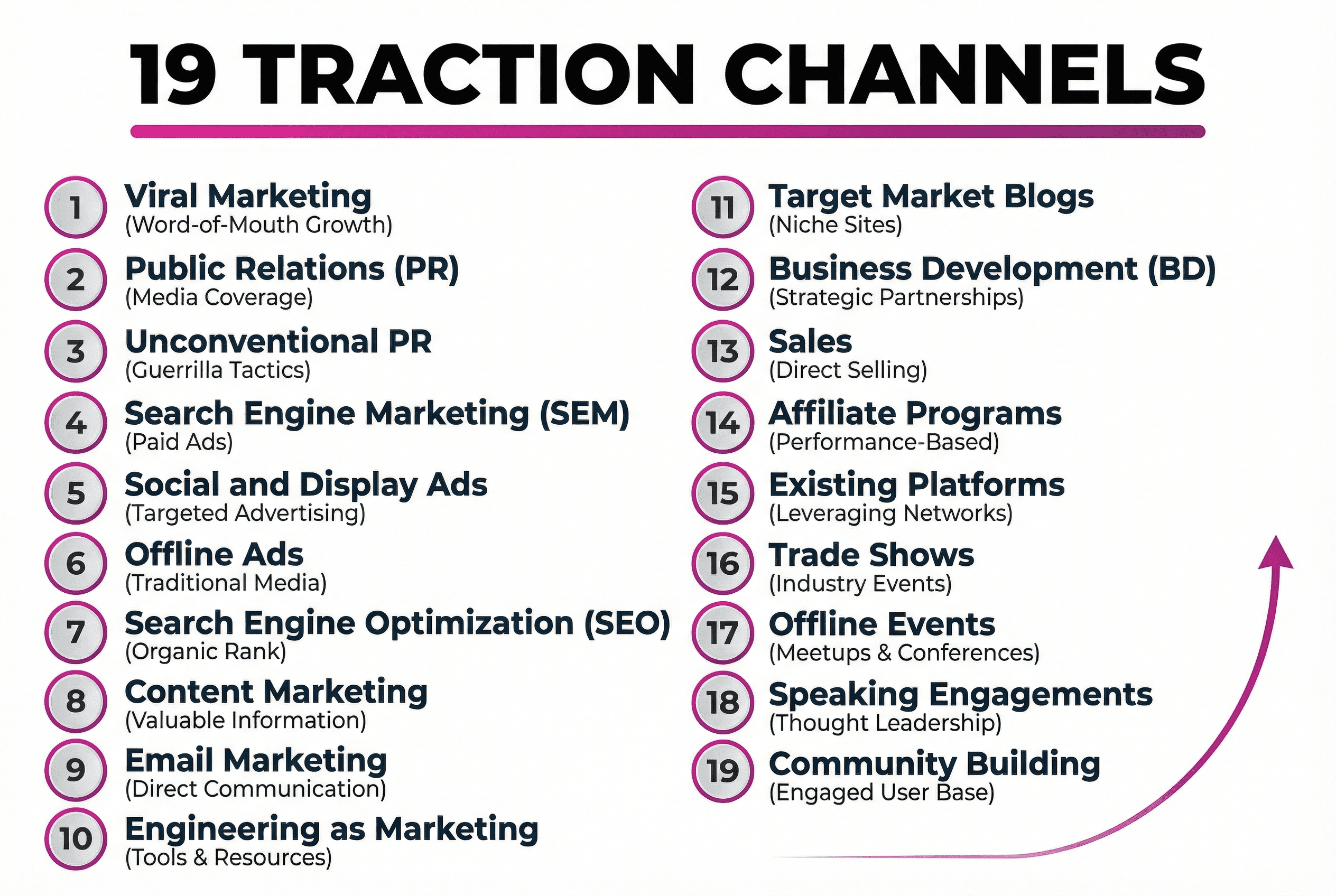
Digital channels: SEO and organic content, paid search (Google Ads), social media organic, social media advertising (Facebook, Instagram, Linkedin), email marketing, SMS campaigns, chatbots and messaging, webinars and virtual events, retargeting campaigns.
Traditional channels: Direct mail (yes, still works for certain segments), print advertising, outdoor (billboards, transit), radio, TV and streaming services.
Hybrid and emerging: Influencer partnerships (alumni, students, faculty), podcast sponsorships, 3d virtual campus tours, AI-powered personalization engines, marketplace platforms.
The schools that are winning right now are using AI to create personalized experiences across all of these marketing channels simultaneously, without drowning their tiny marketing teams.
What You're About to Learn
At the moment, three forces are converging at once:
- Enrollment pressure is intensifying
- Student expectations are rising
- Competition is accelerating
This guide exists to close that gap.
Over the next sections, you’ll see how AI actually fits into university marketing.
Over the next sections, you'll discover how AI transforms higher education marketing strategies and elevates marketing for colleges from reactive to proactive.
🔹 You’ll learn 11 core AI strategies and dozens of tactics and hacks used across branding, marketing, enrollment, content, and growth.
🔹 You'll see exactly how to build an AI marketing tech stack for your institution size. Whether you're a small college with a $2000 monthly budget or a large university ready to invest $15,000+ per month.
🔹 You'll learn which marketing tasks to automate and which ones absolutely need human oversight. This matters more than people realize.
The Results Colleges Are Already Seeing
Let me give you some real numbers before we dive in.
Universities implementing AI marketing strategies are seeing 20-40% efficiency gains across their marketing operations. That means teams are producing twice as much quality content with the same headcount.
Georgia State University deployed an AI chatbot called Pounce. Result → 3.3% enrollment increase and 21% reduction in summer melt. That one deployment likely generated millions in additional tuition revenue.
Schools using predictive analytics for enrollment forecasting are reducing wasted marketing spend by 30-50% while increasing conversion rates 15-30%.
These results demonstrate why forward-thinking higher ed marketing strategies now prioritize AI integration.
What "AI Marketing for Universities" Actually Means
Let's clear something up because there's a lot of hype and confusion floating around.
- AI marketing for universities is not about replacing humans with machines.
- It's not about posting AI-generated content without oversight.
- And it's definitely not about buying every shiny new tool that promises to "revolutionize" your workflow.
That's the hype. Here's the reality…
The Three Levels of AI Implementation
When we talk about AI marketing for higher education, we're really talking about three distinct levels. Most people confuse these, and that confusion leads to underwhelming results.
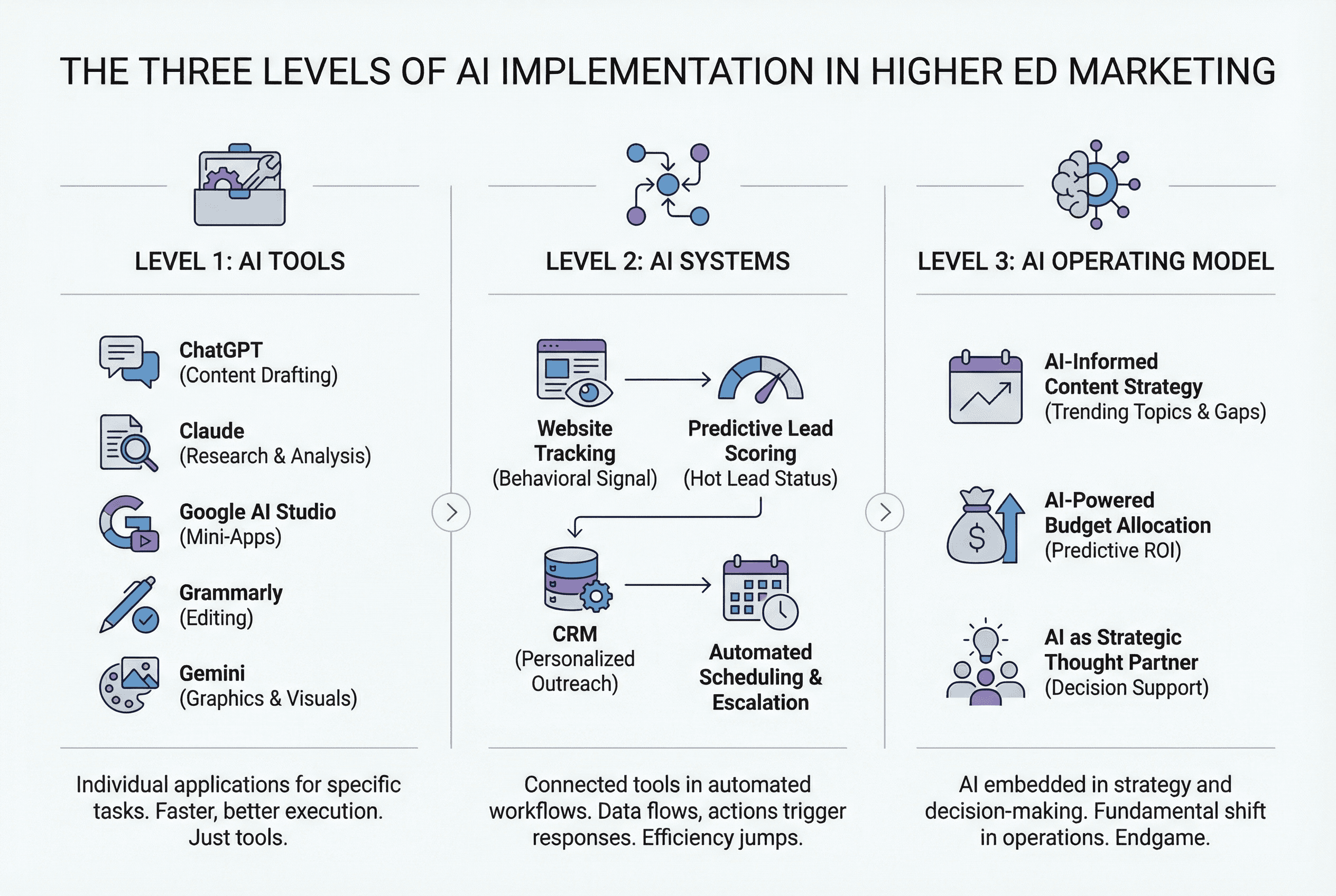
Level 1: AI Tools
These are the individual software applications you use.
- ChatGPT for drafting content.
- Claude for research and analysis.
- Google AI Studio for creating mini-apps.
- Grammarly for editing.
- Gemini for graphics, visuals and images
Think of these as power tools. A really good drill doesn't make you a carpenter, but it makes the carpenter's job way easier. Same thing here. AI tools make specific tasks faster and better, but they're just tools.
Most universities start here. They buy a few subscriptions, maybe run a lunch-and-learn on how to use ChatGPT, and call it an AI strategy.
Level 2: AI Systems
This is where things get interesting. AI systems are multiple tools working together with some automation between them.
Example: Your website tracking system (tool 1) identifies a prospective student who has visited your engineering program page three times in 48 hours and spent 12+ minutes reviewing curriculum details.
- This behavioral signal automatically feeds into your predictive lead scoring model (tool 2), which assigns them a "hot lead" status based on historical enrollment patterns.
- The CRM (tool 3) instantly triggers a personalized outreach sequence: an SMS from an admissions counselor within 2 hours, followed by an email featuring a video message from a current engineering student.
- Simultaneously, the system schedules a one-on-one virtual consultation slot and sends calendar options.
- If the student doesn't respond within 24 hours, the system escalates to the counselor's priority call list with full context of their browsing behavior.
See the difference?
Individual tools are now connected into a workflow that runs partly on autopilot. Data flows between systems. Actions trigger responses. Your admissions team gets warm, qualified leads with complete context instead of cold inquiry forms.
This is where universities see their first major efficiency jumps. Tasks that used to require manual handoffs between team members, now the system handles them. Your team focuses on exceptions and strategy instead of routine execution.
Level 3: AI Operating Model
This is the endgame. An AI operating model means AI is fundamentally embedded in how your marketing department thinks, works, and makes decisions.
- Your content calendar is informed by AI analysis of what topics are trending and what gaps exist.
- Your budget allocation is guided by AI-powered predictive models showing expected ROI, based on past campaign performance.
- Your team uses AI as a thought partner for strategy sessions.
Hardly any universities have reached this level yet.
Most universities experimenting with AI are stuck at the tool layer.
They try a few prompts. Generate a few posts. Maybe write an email draft. Then momentum fades because nothing changed structurally.
There’s another important clarification.
AI marketing does not replace institutional judgment. It augments it.
- AI doesn’t define brand strategy. It helps express it consistently.
- AI doesn’t decide who gets admitted. It helps prioritize outreach.
- AI doesn’t replace counselors. It supports them with context and speed.
Think of AI as a multiplier for clarity.
This is why early wins tend to show up in content and communication first. These are high-volume, repeatable tasks where quality improves with structure. Universities using AI here see faster publishing cycles, stronger engagement, and better alignment across channels.
But the long-term advantage comes from systems thinking.
Instead of asking, which AI tool should we buy, stronger teams ask different questions:
- Where do students drop off today
- Which messages perform best by region
- Which leads convert with minimal human touch
- Which tasks consume the most staff hours
- Where are we losing admitted students to competitor institutions
- What specific objections prevent prospects from applying
- Which geographic markets show high inquiry volume but low conversion
- Which social media platforms drive the most qualified leads per program
AI becomes useful when it is mapped directly to problems like these.
The 11 Core AI Marketing Strategies For Universities & Colleges
STRATEGY #1: AI-Powered Content Creation at Scale
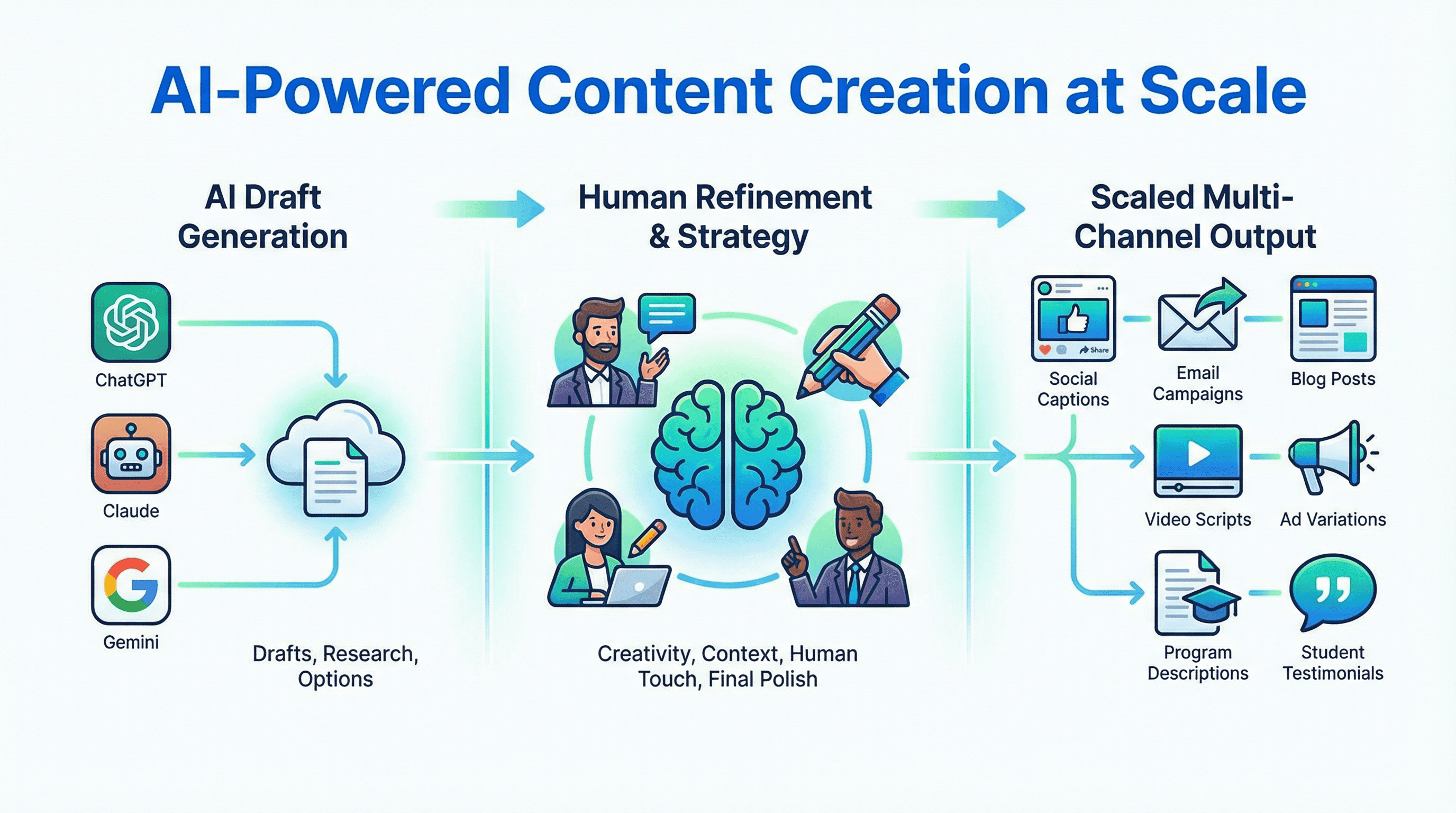
You're using generative AI (ChatGPT, Claude, Gemini) to produce content across every channel. Blog posts. Social captions. Email campaigns. Landing pages. Program descriptions. Ad variations. Video scripts. Faculty bios. Student testimonials. Newsletter content.
But AI never gives you the final version. At most, it gives you a good first draft. It removes the blank page problem. It handles research. It generates 5 social media captions, 10 headlines and 20 subject lines in seconds. But ultimately, it’s your team that picks the right parts and adds their creativity, human touch to craft the desired message.
In a way your team becomes the strategic director guiding AI what direction to take. And that unlocks their highest potential because they’re freed from daily mundane execution.
Content Types Where AI Delivers Maximum ROI
#1 – Updating Program Page Descriptions For SEO & Conversion
Program page descriptions get searched constantly but rarely updated. AI can rewrite all 200 of your program pages in a week, optimized for search and conversion. Your team adds unique selling points and student outcomes.
Pro Tip 1: You can use heat map, scroll map and session recording videos to understand your website visitor’s behaviour and leverage AI to get insights into how to change/update your website to improve conversions. Use tools like Hotjar, Smartlook or Microsoft Clarity.
Pro Tip 2: Use the strategic narrative and its 5 elements to create content for your website and sales – it converts extremely well.
#2 – Creating Truly Engaging Social Media Content
Not only captions but images and videos that connect with students, partners and stakeholders.
Social media captions used to take 20-30 minutes per post. Now they take three minutes. AI generates five options based on different directions and styles while using the context and reference of the accompanying images/video in the post. You pick the best one, tweak it and publish.
Publishing 1 post every day across the entire week is actually quite simple now. You just need to have the right system. Here’s the break down:
- 1 post with image/video = 30 mins max
- 7 posts = 30 mins x 7 = 3.5 hours
- Add 30 mins of scheduling time through a tool like Buffer.
In just 4 hours you can create an entire week’s content, schedule it and then focus on other needle moving initiatives. You constantly show up in front of prospective partners, students and stakeholders non-stop. All you need to have are the right ideas, stories and insights to share.
Pro Tip: For image and video generation, use free tools like Gemini and Grok.
- Check out these 10 use cases of different types of images you can generate using Gemini (Nano Banana Pro) → especially #4, #5, #6 and #9
🎁 Bonus ResourcePrompt Library To Create Content For Social MediaDownload our prompt library to create engaging content for Linkedin, Instagram and X. Copy and paste the prompts in any AI tool and generate a week’s worth of content in a couple of minutes. |
|---|
#3 – Crafting High-Converting Email Nurture Sequences
Email nurture sequences are the highest-converting channel in higher education. They're also the most time-intensive to write. AI can draft multiple versions with different approaches optimised for engagement and conversion.
You can then run A/B tests with subject lines, content copy, call to action to optimise performance over time.
You can take it a step further and create multiple email nurture sequences based on the type, topic or theme of the content they subscribed from.
For example, if a student subscribed from a blog post about student culture vs program page vs an alumni story page – they’ll receive different nurturing sequences because their interests and objectives are different. This creates massive brand resonance and affinity.
Pro Tip: When drafting the content for Gen Z students, try a more personalised and conversational writing style. You can do this by adding in your prompt → “Use a personalised and conversational writing style of the famous copywriter Gary Halbert”
You can mimic anyone’s writing style to create a specific kind of effect, based on your intended outcome.
#4 – Scale Up Your SEO With Blog Content
Blog content for SEO requires volume and consistency. AI handles research, outlines, and first drafts. Your subject matter experts add expertise and credibility.
Gone are the days when you needed to wait 6 months for the SEO effect to kick in. Now you can publish dozens of blog posts every month and start seeing the SEO effect from the first month itself.
Not only this, you can use AI across each step of SEO:
- For keyword research, connect your Google Search Console with Claude or Google AI Studio to uncover high-value, low-competition keywords
- Find the hidden optimization insights to improve the performance of your website pages in Google search
- Generate SEO optimized blog posts at scale
- Find broken links across websites for link building opportunities.
- And so on…
This is the low hanging fruit every university should take advantage of but very few do.
This is also the area where AIxGrowth excels. Talk to us and find out how we can help you scale your SEO and Content Marketing impact.
#5 – Optimize Your Online Advertising With AI
The biggest alpha in online advertising lies in targeting the right audience and testing ad copy variations. AI helps with both.
Most marketing teams don’t realise that the best-performing ad often outperforms average ads by 3-5x. With AI you can generate 50 variations, test the top 10 and then create more variations of the winner. With this never-ending optimization loop marketers can now achieve 5x-10x returns on their ad spend (ROAS).
Here are a few high-leverage tactics for advertising:
- Test your best performing organic content in advertising – engaging organic content works tremendously well in ads.
- Create lookalike audiences based on your highest-performing enrolled students, not just all enrolled students
- Find the best performing ads from your competitor institutions in Facebook Ads Library and adapt them for your own use.
- Set up geo-fencing campaigns around competitor campuses during their open house events
- Use lead form ads with pre-filled information to reduce friction and increase conversion rates by 40-60%
- Run LinkedIn ads targeting guidance counselors and high school administrators, not just students
- Run YouTube pre-roll ads targeting searches for competitor universities and college decision-making content
- Create international student-specific campaigns in their native languages served in their geographic regions
The Human-in-the-Loop Framework
Treat the content generated by AI as a good first draft that needs human touch. So never publish AI content without this three-layer review.
- Layer one is factual accuracy. AI hallucinates. It invents statistics. It misunderstands your programs. Catch this before it goes live.
- Layer two is brand voice. AI sounds like AI unless you train it extensively on your specific voice. Even then, it needs editing. Your brand voice is a competitive advantage. Protect it.
- Layer three is emotional resonance. AI can't feel what your prospective students feel. It can't add the specific detail that makes someone think "this university gets me." That's your job.
STRATEGY #2: Intelligent Chatbots
These are AI-powered conversational interfaces on your website that answer questions 24/7. They’re totally transforming marketing for universities.
They guide prospective students through decision-making. They schedule campus visits. They nudge incomplete applications. They reduce your admissions team's workload by 40-60%.
The Five Layers of Chatbot Strategy Universities Miss
Layer 1 is proactive engagement, not reactive. Bad chatbots wait for students to ask questions. Good chatbots initiate conversations at strategic moments.
- When a prospective student spends 60+ seconds on a program page, the chatbot says → "I notice you're looking at our Computer Science program. I can answer questions about curriculum, career outcomes, or financial aid. What interests you the most?"
- When someone's about to leave the site (exit intent detection), the chatbot offers a personalized resource → "Before you go, want our guide comparing engineering programs? It covers everything you need to make a decision."
- When a return visitor comes back for the third time, the chatbot knows → "Welcome back! You've been researching our Business programs. Ready to schedule a call with our admissions counselor?"
Layer 2 is personalization based on behavior. The chatbot sees what pages students visit, what content they download, and where they're located. It adjusts responses accordingly.
- International students get information about visa processes, housing, and English language support.
- In-state students hear about affordability and proximity.
- Transfer students learn about credit evaluation and program pathways.
Layer 3 is multilingual support. Your prospective students speak 15+ languages. Most speak English as a second or third language. Offering chat support in their native language builds trust immediately.
- Auto-detect browser language
- Offer instant translation
- Use culturally appropriate messaging and examples
- Ensure seamless handoff to bilingual counselors when needed
Layer 4 is crafting personality that matches your brand. A chatbot for a prestigious research university sounds different than one for a community college.
- Match formality levels to your brand.
- Use emojis appropriately for Gen Z audiences.
- Keep response length short for mobile users.
- Test different personality options with student focus groups.
Layer 5 is the seamless handoff to humans. AI handles routine questions like application deadlines, program requirements, and campus location. When conversations involve complex financial situations, personal circumstances, or emotional concerns about leaving home, the chatbot recognizes it's beyond its scope. It says something like "This is an important decision - let me connect you with Sarah from our admissions team who can give you personalized guidance."
The human counselor receives the full chat history and student context before joining, so the student never has to repeat themselves. The transition feels natural.
The Advanced Triggers That Drive Enrollment
- Time on page over 60 seconds signals serious interest. The chatbot should engage.
- Scroll depth past 75% means they're reading carefully. Offer related content or next steps.
- Return visitors (three or more visits) are high-intent. Schedule a call or campus visit.
- High-value page visits like program pages, tuition calculators, and application pages deserve immediate engagement.
- Application abandonment triggers follow-up within minutes, not days. "I see you started an application. Can I help with anything?"
The Summer Melt Problem AI Solves
Summer melt is when accepted students ghost universities and colleges between May and August. They don't show up for fall semester. You lose 10-30% of your incoming class.
AI chatbots reduce melt by staying in touch. They send reminders about housing deadlines, financial aid paperwork, orientation registration, and immunization requirements.
They answer last-minute questions about roommate selection, course registration, fee payment and other processes that can otherwise be confusing to understand leading to drop offs.
Without naming names, one mid-size private university reduced summer melt from 18% to 11% using automated chatbot nudges combined with human counselor outreach for at-risk students.
STRATEGY #3: AI-Driven Visual Content That Stops the Scroll
Here’s the reality of the Attention Economy → students scroll past 100+ social media posts per day. Your university's post has 0.5 seconds to capture attention.
Text-only posts get ignored. Generic stock photos get ignored. Only visually compelling content breaks through.
This is where you use Gen AI tools like Gemini (Nano Banana Pro), Midjourney, Meta, Grok. They already have the world’s knowledge and they can create scroll-stopping content without hiring a design team.
The AI Image Generation Tools
- Gemini 3.0 with their Nano Banana Pro is the current leader.
- Grok Imagine works tremendously well.
- Midjourney creates photorealistic images.
- Meta AI
- Adobe Firefly has multiple AI graphic tools to generate images
Visual content has become non-negotiable in modern marketing strategies for universities. While traditional higher ed marketing relied on stock photography, today's successful marketing for colleges demands authentic, AI-generated visuals that reflect genuine student experiences.
The Visual Content Types That Drive Engagement For Universities
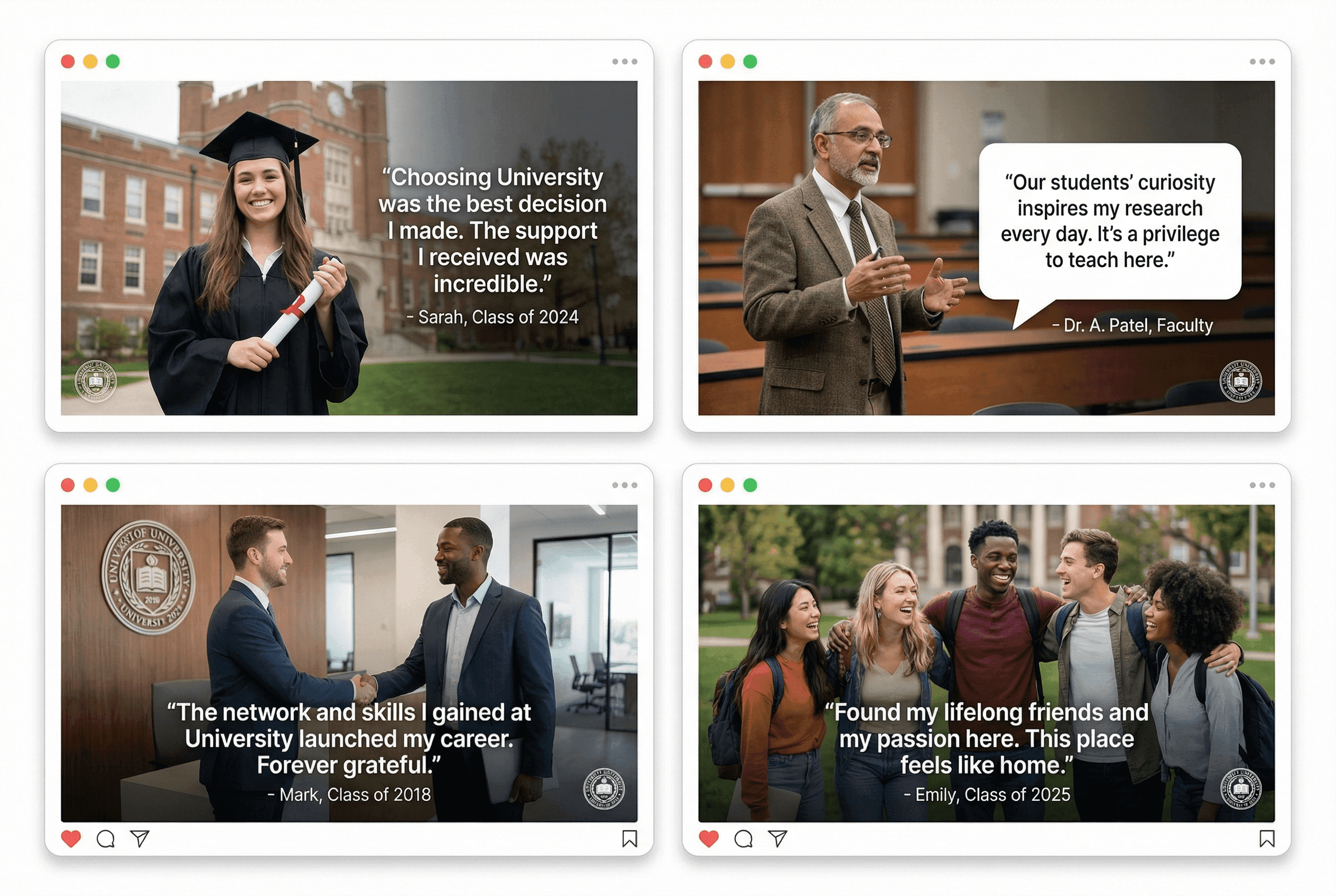
- Quote graphics from students, faculty, or alumni. Real quotes overlaid on campus imagery or abstract designs. "Choosing University was the best decision I made. The support I received was incredible." - Sarah, Class of 2024.
- Stat graphics that visualize your competitive advantages. "93% employed within 6 months" with bold typography and brand colors.
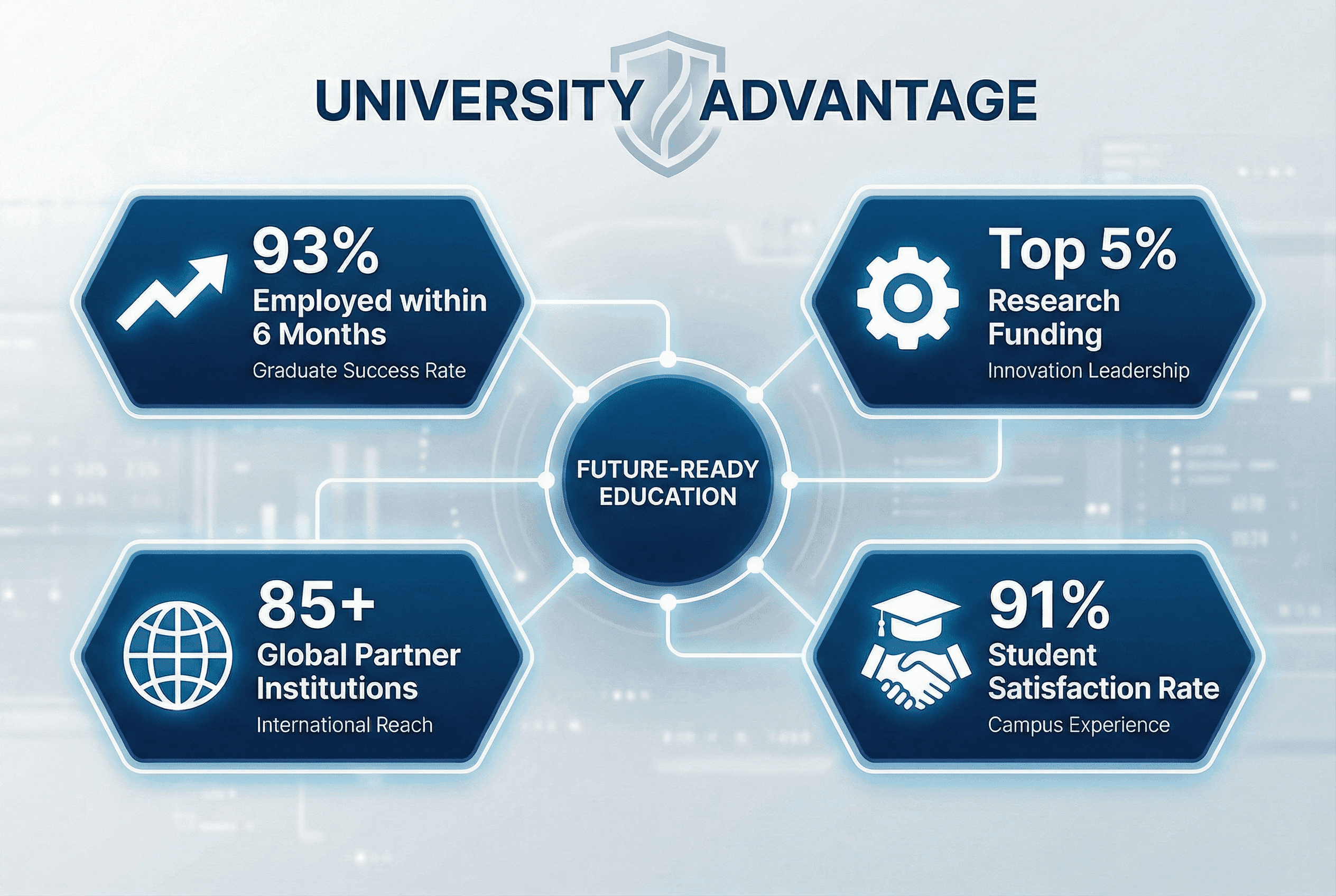
- Before/after transformations that show student growth. "Day 1 freshman" vs. "Graduation Day CEO of student startup."
- Campus beauty shots that showcase your facilities and environment. These perform consistently well on Instagram and Facebook.
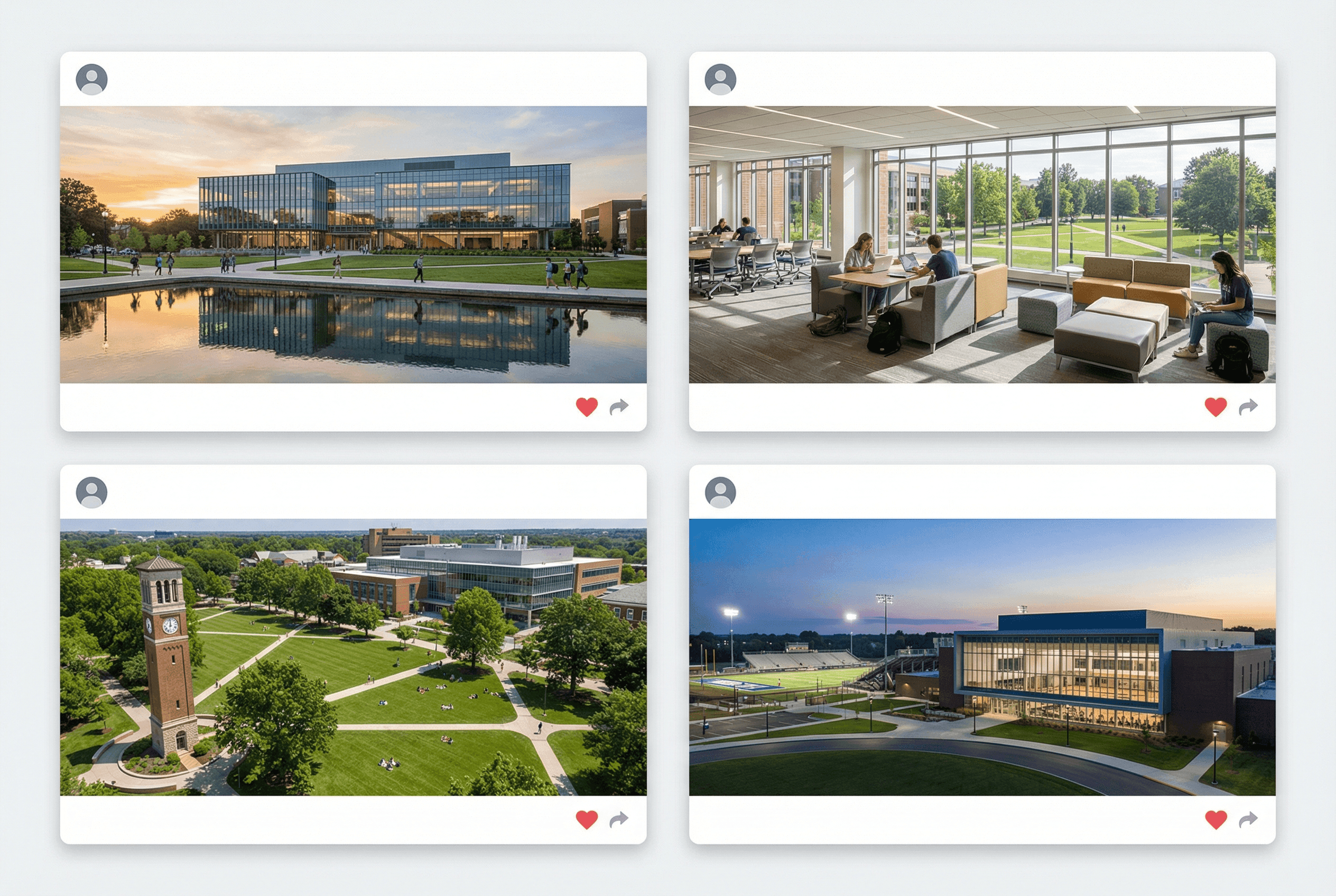
- Program highlight graphics that break down curriculum, career paths, or unique features. Infographic style with icons and clear visual hierarchy.
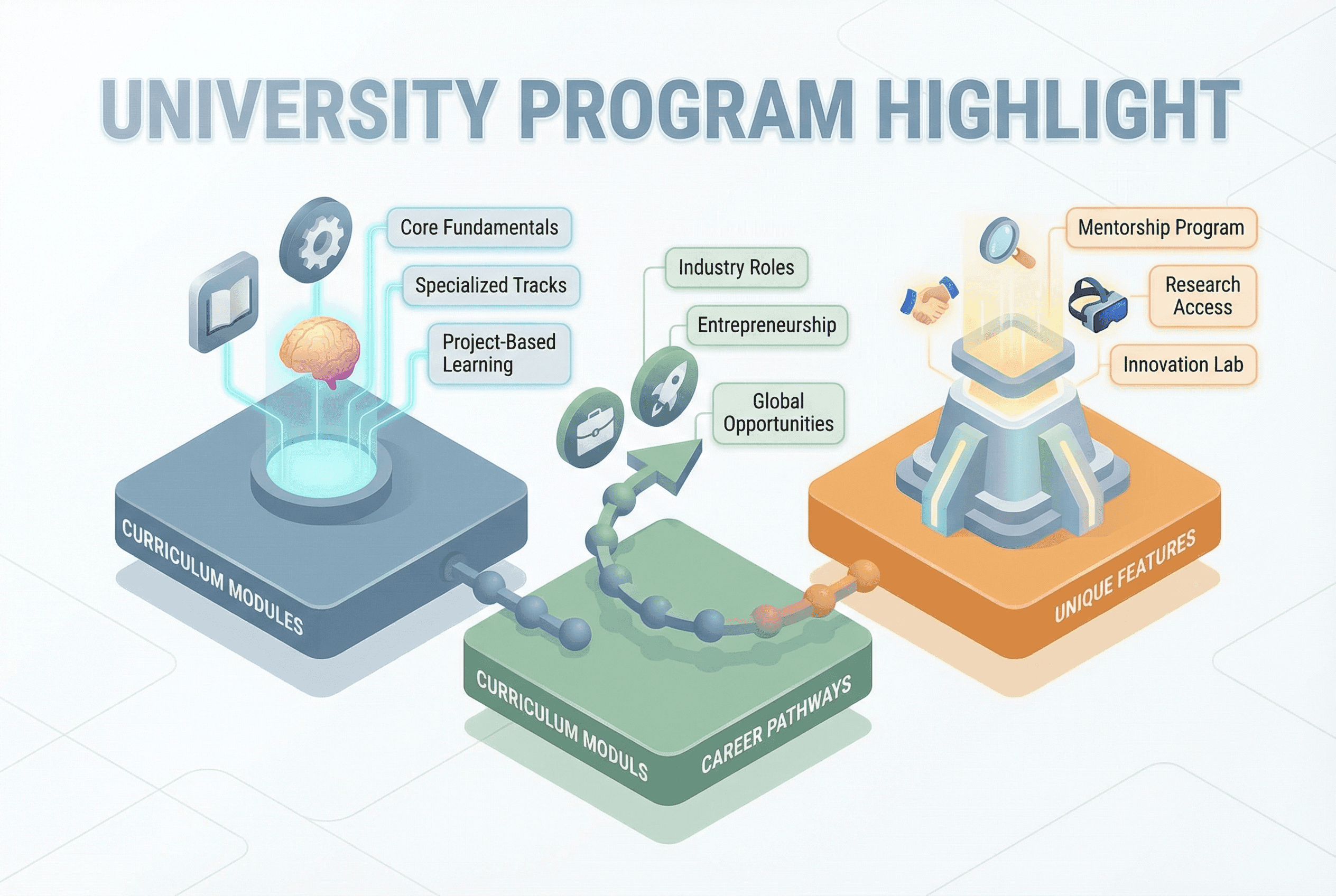
The AI Video Content You Can Create Without a Videographer
AI video tools are evolving rapidly. The three best in the market at the moment:
- Grok Imagine
- Google Veo 3.1
- Kling AI
You can use their text-to-video capability and create 10 second videos on anything you can imagine. A few examples to tickle your imagination. Feel free to try them yourself.
Text-to-video Prompt 1
Prompt: A soft, diffused natural light video of a college professor standing in front of the main building of Harvard College. Next to him a semi-transparent, glowing green AR data tag identifying 'University Marketing' slowly floats up. He taps the digital card and the screen types out more information on – 5 AI Strategies For University Marketing along with 5 short strategies of one sentence each. The camera holds a wide, steady shot, emphasizing the depth and the university campus in the background.
Text-to-video Prompt 2
Prompt: A bright university classroom video with a professor standing beside a large digital screen. Floating text appears: “MS in Data Science.” As the professor gestures, three clean animated icons appear one by one labeled “Curriculum,” “Career Outcomes,” and “Industry Projects,” each with a short one-line description. Soft daylight, traditional academic atmosphere of a US university classroom, slow camera push-in, calm and professional tone.
Text-to-video Prompt 3
Prompt: A warm, golden-hour hyper-realistic video montage of diverse students walking across a university campus, studying together, laughing in common areas (body-aware subjects). Minimal animated captions fade in: “Learn,” “Collaborate,” “Belong.” The camera moves gently, handheld but steady, with soft sunlight and natural motion. Ends with a subtle text overlay: “Your campus. Your future.”
Text-to-video Prompt 4
Prompt: A focused shot of Harvard university main building at sunset. A clean animated countdown overlay appears: “Applications Closing In 7 Days.” Subtle motion graphics pulse softly. Warm lighting, steady camera, dramatic but calm tone.
Text-to-video Prompt 5
Prompt: A calm indoor video of a senior professor sitting near a window-lined office. Subtle animated text appears beside them in a semi-transparent, glowing green AR digital screen:
Heading – “The Future of Higher Education.”
Professor doesn't speak, three short text insights show up below the heading. Soft daylight, shallow depth of field, neutral academic background, slow static camera.
Text-to-video Prompt 6
Prompt: A first-person POV-style video showing a student entering a classroom, taking notes, walking across campus, and studying at night. Simple text overlays appear briefly: “Morning Class,” “Group Study,” “Late Nights, Big Dreams.” Natural lighting changes through the day, smooth motion, realistic campus energy.
Then comes image-to-video and video-to-video capabilities of the AI tools that opens up many more use cases.
Leverage Thumbnail Optimization To Multiply Video Views
Your video content lives on YouTube, social media, and your website. The thumbnail determines whether anyone watches.
AI can generate and test thumbnail variations. Feed your video content to ChatGPT. Ask for 10 thumbnail concepts that would maximize clicks.
Create those thumbnails using Gemini’s Nano Banana Pro or Canva's AI tools or Midjourney. Test them on small audience segments. Scale the winner.
Small thumbnail improvements can 2-3x your video view rate.
STRATEGY #4: Predictive Analytics For Enrollment
Machine learning models analyze thousands of data points about your inquiries and applicants. They predict who's likely to convert, who needs extra attention, and who's about to ghost you.
You stop wasting marketing spend on low-intent leads. You focus resources on high-potential students. You identify at-risk applicants before they disappear.
Universities using predictive analytics reduce wasted marketing spend by 30-50% and increase conversion rates by 15-30%.
The Four Signal Categories Your Predictive Model Needs
Behavioral signals carry the most weight (40% in most models). Website visit frequency and recency matter more than almost anything. Someone who visits five times in three days is hot. Someone who visited once six weeks ago is cold.
- Email engagement (opens, clicks, link clicks) shows interest level.
- Event attendance, whether virtual webinars or campus visits, predicts enrollment better than test scores in many cases.
- Application progress matters. Someone who started an application is 8x more likely to enroll than someone who requested information.
Demographic factors contribute 25% to most models. Academic qualifications like GPA and test scores matter, but not as much as behavior. Geographic location helps predict likelihood, especially distance from campus. Intended major matters because some programs have higher yield rates. High school profile and family income indicators add context for financial aid requirements.
Source & engagement quality deserves 20% of the weight. The source of the inquiry matters.
- Students who find you through organic search convert better than those from bought lead lists.
- The type of content they consume signals intent. Someone reading about career outcomes is closer to deciding than someone reading about campus life.
- Question complexity during counselor interactions reveals how seriously they're considering you.
Timing signals complete the model at 15%. Days in the funnel tells you if someone's moving too slowly. Application submission timing relative to deadlines matters. Response patterns to outreach reveal engagement. Proximity to deposit deadlines triggers urgency.
Use Cases of Predictive Models for University Enrollment
- Enrollment yield prediction helps you forecast incoming class size three months before deposits are due. You can adjust recruitment spend accordingly.
- At-risk applicant identification catches students likely to abandon their application. Trigger immediate intervention.
- Scholarship optimization models tell you the minimum scholarship amount needed to secure enrollment. Stop over-awarding high-intent students.
- Program interest prediction identifies students likely to switch majors. Market alternative programs proactively.
- Transfer student success prediction helps you identify which transfer applicants will actually complete degrees. Improve graduation rates.
How to Actually Build Predictive Models Without a Data Science Team
Most universities think predictive analytics requires a PhD in statistics and a six-figure budget. It doesn't.
Option 1: Start with your CRM's built-in predictive features. HubSpot, Salesforce, and Slate all have predictive lead scoring already built in. It's not perfect, but it's 80% as good as custom models and requires zero technical expertise. Turn it on, let it analyze your data for a couple of months, and start using the scores it generates.
Option 2: Use your existing spreadsheet data with AI. Export your last two years of leads data into a spreadsheet - inquiries who enrolled versus inquiries who didn't, along with their characteristics (demographics, engagement metrics, source). Upload this to ChatGPT or Claude and ask it to identify the top 10 patterns that predict enrollment. You'll get actionable insights in minutes without writing a single line of code.
Option 3: Leverage Google Sheets with Google AI Studio. If you have historical data in Google Sheets, connect it to Google AI Studio and build a simple predictive model in under an hour. The AI helps you identify which variables matter most and creates a scoring formula you can apply to new inquiries automatically.
Once you have a basic model running, refine it and continue to optimise.
The key is to start simple. You don't need perfection on day one. A basic predictive model that's 70% accurate is infinitely better than treating all 10,000 inquiries exactly the same.
STRATEGY #5: Hyper-Personalized Email and SMS Strategy
Email converts 3-5x better than social media for enrollment marketing. SMS converts even better for time-sensitive messages. But most universities are still not using them to the fullest. AI can bridge this gap.
AI-driven personalization means every student gets content matched to their interests, behavior, location, and stage in the decision process.
Dynamic Content Blocks That Take Personalization To The Next Level
Your email template has five content blocks – the hero image, headline, body content, call-to-action, and PS section.
- For a prospective engineering student from California who's visited your robotics lab page three times, the email shows → robotics lab photos, discusses your Silicon Valley industry partnerships, highlights your California alumni network, and offers a virtual tour of engineering facilities.
- For a prospective business student from Texas interested in entrepreneurship who attended your webinar on startup incubators, the email features → student founder stories, details your entrepreneur-in-residence program, mentions your Austin connections, and invites them to pitch night.
Same email campaign. Completely different content. All automated.
Behavioral Trigger Sequences That Nurture Without Being Annoying
Someone downloads your engineering program guide. They get a three-email sequence over two weeks.
- First email shares student success stories in engineering.
- Second email explains internship and co-op opportunities.
- Third email invites them to a virtual Q&A with faculty.
Someone starts an application but doesn't finish.
- Wait 24 hours. Send an email asking if they need help.
- Wait three days. Send an SMS with a direct link to where they left off.
- Wait one week. Send a video message from an admissions counselor offering to hop on a call.
Someone gets accepted but hasn't deposited.
- Send a congratulations email immediately.
- Wait one week. Send financial aid resources and scholarship opportunities.
- Wait two weeks. Send a message from a current student in their intended major.
- Wait three weeks. Remind them about housing deadlines.
Each trigger is automated. Each message is personalized. No manual work required.
The Timing Optimization AI Delivers
Most universities send emails at 10am on Tuesdays because that's what some blog post from 2015 said was optimal.
AI analyzes when each individual student engages with your emails. Some open emails at 8am before school. Some open at 9pm before bed. Some are weekend readers.
The AI adjusts send time for each person. Your open rates increase 15-30% immediately.
Subject Line Testing at Scale
You used to A/B test two subject lines per email. With AI, you test 10-20 variations simultaneously.
- The AI generates subject lines based on high-performing patterns.
- It tests them across small audience segments.
- Then automatically sends the winner to the remaining audience.
Example of subject line variations for a campus visit invitation:
- See yourself at [University Name] - Schedule your visit
- Still deciding? A campus visit might help
- Your personalized campus visit is waiting
- [First name], ready to visit campus?
- Campus visit slots filling up - grab yours
The AI learns which patterns work best for different audience segments and leverages it in future campaigns.
SMS Strategy That Doesn't Feel Spammy
SMS has 98% open rates compared to 20% for email. But universities are terrified of using it because students might find it “intrusive”.
Here's what works…
- Get explicit opt-in. "Want application deadline reminders via text? Reply YES."
- Keep messages short. Under 160 characters. One clear action.
- Send sparingly – major deadlines, application status updates, event reminders. Not promotional content.
- Personalize based on urgency. A student three days from an application deadline gets an SMS. A student three months out gets email.
- Make opting out easy. "Reply STOP to unsubscribe" in every message.
Here’s an example SMS that works:
"Hi Maya, just a heads up that the early application deadline is Friday, 15th Jan. Your application is 80% complete. Need help finishing? Reply YES and we'll call you."
The Audience Segmentation Strategy
In 2026, it makes no sense to send the same email to everyone who requested information.
You need to personalise content based on these categories:
- Inquiry source: Students from organic search have different needs than students from paid ads or college fairs.
- Intended major of study: This determines the content relevance. Engineering students want to hear about labs and career outcomes. Arts students want to hear about faculty and creative opportunities.
- Geographic location: This affects messaging. Local students care about community connections. Out-of-state students need help imagining themselves on campus. International students have their unique concerns of safety and culture change.
- Application stage: Inquiries/leads get educational content. Applicants get status updates and next steps. Accepted students get content about financial aid, housing options, etc.
- Parent vs. student: Parents care about ROI, safety, and support systems. Students care about experience, community, and independence.
Re-engagement Campaign To Rescues Dead Leads
30-40% of your leads go cold. They requested information six months ago, haven't engaged since, and seem gone forever. Don't delete them. Re-engage them.
Send a "We Miss You" campaign. Three emails over three weeks.
- First email acknowledges the gap and offers fresh content.
- Second email shares what's new at your university.
- Third email gives them an easy way to re-engage or opt out.
For students who still don't engage, try SMS → "Hi [Name], we haven't heard from you in a while. Still interested in [Major] at [University Name]? Reply YES or NO."
This helps filter out completely dead leads.
One university reactivated 12% of dead leads using this sequence. That's 600 inquiries from a list of 5,000 that seemed worthless.
STRATEGY #6: WhatsApp Communities That Create Belonging Before Students Arrive
WhatsApp has 2 billion users globally. It's the primary communication tool in India, Latin America, Middle East, Africa, and parts of Asia. Your international prospects expect to communicate there, not via email.
But here's the bigger opportunity – WhatsApp Communities let you create shared spaces where prospective and current students connect. They build relationships before enrollment. They reduce summer melt. They create peer-to-peer influence that's more powerful than any marketing message you could send.
The WhatsApp Community Structure
Don't create one massive WhatsApp group. Create multiple groups based on meaningful segmentation.
- Communities by geographic region work best for international students. All Indian prospects in one community. All Brazilian prospects in another. Current students from these countries serve as ambassadors and answer questions.
- Communities by intended major create program-specific connections. All engineering program prospects connect with engineering students. All business program prospects connect with business students.
- Communities by identity create belonging. First-generation college students find others like them. Student athletes connect with current athletes.
Each community has clear purpose, active moderation, and regular valuable content. Not just promotional spam.
Content That Drives Engagement In WhatsApp Communities
- Student Takeovers: where a current student runs the community for a day. They share their schedule, classes, meals, activities, and honest perspectives. Prospective students see authentic campus life.
- Weekly Q&A Sessions: with faculty, admissions counselors, financial aid advisors, and current students. Live question answering builds trust faster than any brochure.
- Behind-the-scenes Content: that shows what prospective students can't see elsewhere. Research labs, student performances, campus traditions, local food spots, study spots.
- Peer-to-peer Introductions: "Everyone new this week, introduce yourself! Where are you from and what do you want to study?" Prospective students start building friendships and connections even before they’ve enrolled.
- Application Support During Deadline Season: Quick reminders, deadline countdowns, encouragement, building anticipation – this helps keep students engaged.
Leverage Ambassador Program To Scale WhatsApp Communities
Your team can't personally manage 15 WhatsApp communities. You need student ambassadors.
Recruit current students who are active, engaged, and represent diverse backgrounds. Pay them a stipend or offer course credit. Train them on brand messaging, appropriate content, and how to escalate questions they can't answer.
Each ambassador manages one or two communities. They post daily content, welcome new members, answer questions, and flag serious concerns for admissions staff.
Every university can easily run 10 WhatsApp communities with 5-8 student ambassadors. If each community holds on average 200 members, your team is reaching 2000+ prospective students repeatedly without any extra effort.
Automated WhatsApp Onboarding That Feels Personal
Someone new joins your WhatsApp community. They immediately get a 1-to-1 welcome message with community guidelines and what to expect. This can be automated through WhatsApp Business API.
They get added to a contact list that triggers a drip sequence.
- Day 1: Welcome and introduction to ambassadors.
- Day 3: Link to most popular community resources & FAQ doc.
- Day 7: Invitation to upcoming live Q&A.
- Day 14: Personal check-in from an ambassador.
Automation handles the structure. Humans handle the conversation.
How WhatsApp Communities Reduce Summer Melt
Accepted students who join pre-enrollment WhatsApp communities are 40% less likely to melt between May and August. They've built relationships. They feel connected. They've started identifying as part of your university community.
The community keeps them engaged during the gap months with housing selection tips, course registration advice, moving day logistics, roommate connections, local area recommendations.
When students arrive on campus, they already have friends. They've already talked to people in their major. They already feel like they belong.
STRATEGY #7: Conversion Rate Optimization That Turns Traffic Into Applications
Your marketing team is doing everything to drive traffic to your website. Organic search, paid ads, social media, email campaigns. But most visitors leave without taking action.
Your blog & website gets 10,000 visits per month. 100 people request information. That's a 1% conversion rate. Industry average is 2-4%. Top performers hit 6-8%.
If you optimize conversion rate from 1% to 3%, you triple inquiries without spending another dollar on traffic.
The Exit Intent Popup
Someone's about to leave your website. Their cursor moves toward the browser's back button. An exit intent popup appears with a compelling offer.
This is possible through the exit intent technology that’s now commonly available in many marketing tools like Optinmonster, Poptin, OptiMonk, etc.
What really matters in exit intent popups is the offer and the way it is presented. Analyse these two versions and guess which one converts better…
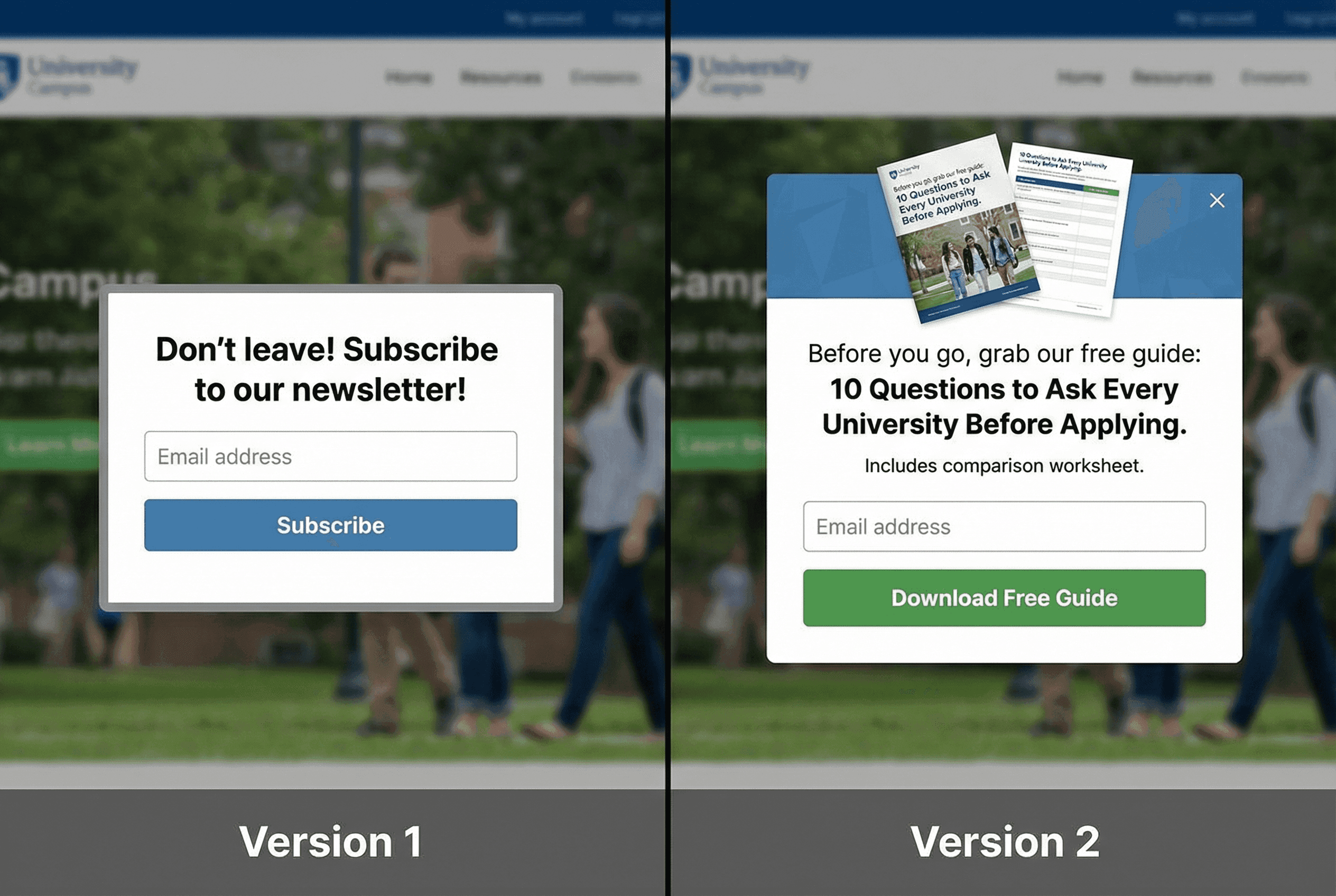
Version 2 converts way better because it gives immediate value, is relevant to their decision process and is offered for free.
Test different lead magnets in your exit intent for different audience segments. With our clients we’ve seen this play out over and over again where we’re able to 2x-5x their conversion rate by using segmented lead magnets in exit intent popups.
The Weekly Webinar System That Runs on Autopilot
Most universities run webinars sporadically. You plan one, promote it for three weeks, deliver it live, then nothing for two months.
Here’s a better approach → Evergreen automated webinars that run 2x weekly.
Record your best admissions webinar once → "Everything You Need to Know About Applying to [University Name]." Professional production, engaging slides, clear call-to-action.
Set it to run every Tuesday at 7pm and every Saturday at 11am.
Prospective students register and attend the automated webinar. At the end, they're invited to schedule a one-on-one call with an admissions counselor. Or you can introduce a staff member to do a live 15 minute Q&A at the end of the webinar.
The webinar runs 104 times per year. Zero additional effort after initial setup. Continuous lead nurturing.
Now take it to the advanced level → Create program-specific automated webinars.
- Engineering program overview.
- Business school insights.
- Nursing program details.
Students self-select into the most relevant content.
Conversion Snippets On Blog To Capture Leads
Sorry to say but most university blogs are terrible at conversion. Great content, zero calls-to-action. Students read your blog post, enjoy it, then leave.
My sincere request – please add conversion mechanisms to every blog post, like:
- In-content CTAs after the first major section. "Want to experience campus life yourself? Schedule a visit."
- Sidebar opt-in forms with relevant lead magnets. If they’re reading about financial aid, offer a financial aid guide.
- End-of-post CTAs that match the content topic. If the blog post is about career outcomes, add a CTA to talk with career services.
- Related content links to high-conversion pages. Blog post about academic programs offered in the university links to individual program pages with inquiry forms.
Landing Page Optimization For Conversion, Not Just SEO
Your paid ads, email campaigns and blog posts drive traffic to program landing pages. These pages have one job – convert visitors into inquiries or applications.
Most university program pages convert at 2-4%. Top performers hit 10-15%.
The difference comes down to a few key elements.
- Headline clarity: The visitor should understand your unique value proposition in five seconds. "Online Business Degree. Graduate in 18 months. No GMAT required." vs. "Transform Your Future" (which is meaningless).
- Social proof above the fold: Student testimonials, employment stats, or rankings visible immediately. "94% of graduates employed within 6 months."
- Clear single call-to-action: Don't give visitors 10 options. Give them one. "Request Information" or "Start Your Application."
- Minimal form fields: Every field you add reduces conversion by 5-10%. Start with name and email. You can collect more information later.
- Video that adds value: A 60-second program overview from a faculty member or student testimonial. Not a generic brand video.
- Mobile optimization: 70% of your traffic is mobile. If your landing page doesn't work perfectly on mobile, you're losing half your potential inquiries.
Underrate Hack – The Multi-Step Form That Increases CompletionLong inquiry forms scare people away. Asking for 12 pieces of information upfront tanks conversion. Multi-step forms break the process into smaller, less intimidating steps.
Completion rates increase 20-40% because each step feels manageable. The psychological commitment of completing step one makes people more likely to finish steps two and three. |
STRATEGY #8: Amplify Your Social Media By Turning Your Community Into Your Marketing Team
Your marketing team posts on social media. It gets modest engagement. Maybe 100 likes, a few shares, minimal reach.
But when your faculty, staff, students, and alumni share content, it reaches 50-100x more people. It's also trusted more because it comes from individuals, not an institution.
But the problem is that most of these people don't post regularly because creating social content feels hard. AI removes this barrier.
The Faculty Thought Leadership
Your faculty are experts. They have insights worth sharing. They could build substantial LinkedIn followings that attract prospective students to your programs.
But they don't have time to write posts, don't know what to post, and feel awkward about self-promotion.
You have two ways to go about this:
Approach 1: Give them ChatGPT prompts that turn their idea and expertise into LinkedIn content in 60 seconds.
Approach 2: Give them a custom GPT that’s trained on your brand voice, language and color theme. It generates 150-word posts in an engaging way that doesn’t sound like it’s AI-generated.
In either case, the faculty member edits the AI-generated content for accuracy and posts it. The university reshares it.
Your goal is to cut down the content creation time and effort for your faculty. If you do this right, you have faculty-generated thought leadership content that showcases your academic strength. No marketing team effort required.
Student Ambassador Program For Marketing of Universities
I’m about to share a truly mind-blowing idea that I haven’t seen any university implement yet. If you know of any, write to me, I’d love to feature them here.
Just like you created ambassadors in WhatsApp communities, you can find 50-100 social media ambassadors from your current students. Here’s how:
Step 1 – Create a credit-earning social media marketing course
- Design a 3-month virtual program specifically teaching social media marketing through the lens of higher education marketing
- Position it as a practical, hands-on learning experience where students learn real marketing skills while promoting their own university
- Offer academic credit or a professional certificate upon completion
- Open enrollment to students across all disciplines to get diverse perspectives and authentic voices
Step 2 – Structure the program for consistency
- Run weekly 60-minute live sessions covering theory, best practices, and real-world examples specific to university marketing
- Require each enrolled student to post 2x per week (minimum) about authentic university experiences - campus life, academic insights, student organizations, local discoveries, behind-the-scenes moments
- Create a WhatsApp group where students share ideas, give feedback, and collaborate
Step 3 – Provide students with content frameworks and creative direction
- Give students a content idea bank organized by themes:
- academic life,
- student culture,
- local area guides,
- program-specific insights,
- day-in-the-life, study tips,
- campus resources,
- social events,
- faculty spotlights,
- career preparation,
- behind-the-scenes access
- Provide angle variations for each theme so students can find their unique voice - humorous, inspirational, educational, documentary-style, comparison/myth-busting, Q&A format
- Teach storytelling frameworks they can apply
- Encourage students to share their genuine experiences - both challenges and wins - for authenticity
Step 4 – Build engagement loops and recognition systems
- Track weekly posting consistency through a shared dashboard showing who's maintaining their 2x/week commitment
- Spotlight the "Post of the Week" based on engagement metrics (likes, comments, shares, saves) and feature it in the next session
- Share weekly performance insights: "This week, posts about [topic] got 3x more engagement than average - here's why"
- Build accountability buddies - pair students to support each other, review drafts, and stay motivated
These authentic student posts reach their friends, family, and social networks. Prospective students see real experiences, not polished marketing.
Here’s the simple math:
- Students enroll for the program = 50
- Across the 3 month program, each student posts on avg = 20 posts
- Total posts = 1000
- Avg reach of each post = 200 unique people
- Total reach in 3 months = 200,000 unique people
That’s $30,000-40,000 worth of paid social reach if you had to buy it. 🤯
If this really blows your mind and you want to implement it in your university or college, but don’t have the bandwidth. Talk to us, this is what we do best.
Activate Your Alumni Network
Like your current students, your alumni also care about your institution. They want to help. But they don't know how. Make it easy for them to share your content.
Create a monthly alumni social media toolkit.
- First week of every month your alumni receive 5 pre-written post options about recent university news, student achievements, or program updates.
- Including images and suggested hashtags.
- Ask them to tag your official page.
- Reshare alumni posts from your official page.
Alumni copy, paste, personalize if desired, and post. It hardly takes them a minute.
Imagine seeing a post like this…
"Proud to see my alma mater ranked #1 in the state for engineering programs. Future engineers, you should check this out."
Alumni networks are powerful for recruitment. Prospective students trust recommendations from graduates who've succeeded professionally. And there’s no reason why in 2026 you shouldn’t leverage your alumni network to build your brand visibility.
Multiply Reach Using The Content Repurposing System
Your marketing team creates one piece of content, let’s say a blog post about new research facilities. AI repurposes it into 15 different social media assets.
- Three LinkedIn posts highlighting different angles (research impact, student opportunities, faculty expertise).
- Five Instagram posts with visual quotes and stats.
- Three Twitter threads breaking down key points.
- Two TikTok script ideas for student ambassadors.
- Two Facebook posts for parent audiences.
You created one thing. You published 15 things across five platforms. All customized for platform and audience.
This is among the most high leverage AI strategies you can use for your university.
STRATEGY #9: AI-Enhanced Paid Advertising That Cuts Cost Per Enrollment in Half
Paid advertising costs are increasing 10-15% annually. Competition for student attention is fierce. Your $500,000 paid media budget is delivering fewer results year over year.
AI changes the game in three ways → creative generation, audience targeting, and campaign optimization.
Creative Generation at Scale
The best-performing ad usually outperforms the average ad by 3-5x. But most universities test 3-5 ad variations per campaign. AI lets you generate and test 50-100 variations.
Feed your historical best-performing ads into ChatGPT with a prompt like → "Generate 50 variations of this ad headline for Instagram ads targeting prospective engineering students."
You get 50 options in 30 seconds. Your team selects the top 15. You test them. The winning ad becomes your new control.
Same process for ad images. Feed reference images to Gemini with prompts like → "college campus scene with diverse engineering students collaborating on robotics project, bright natural lighting, professional photography style."
Generate 20 image options. Test them. Scale the winners.
Dynamic Creative Optimization
Meta and Google offer dynamic creative optimization. You upload multiple headlines, descriptions, and images. The algorithm tests combinations and serves the best-performing versions.
Most universities upload 3-5 options per element. That's not enough for the algorithm to optimize effectively.
Use AI to generate 10 headlines, 10 descriptions, and 20 images. The platform now has 2,000+ possible combinations to test. It finds winners faster and optimizes more aggressively.
Audience Building with Predictive Modeling
Your CRM contains thousands of enrolled students. These are your best customers. Build lookalike audiences based on their characteristics.
- Traditional approach: Export enrolled student data, create a lookalike audience in Meta Ads Manager, target them.
- AI-enhanced approach: Use predictive modeling to identify the characteristics of enrolled students who have the highest lifetime value (complete degree, engage as alumni, donate, refer others). Build lookalike audiences based on this refined segment, not all enrolled students.
You're now targeting people who look like your best students, not your average students.
Progressive Retargeting Sequences
Someone visits your website but doesn't inquire. Most universities show them generic retargeting ads for weeks.
Better approach → Progressive retargeting ad sequences that match the buyer journey.
- Week 1: Educational content. "Still researching programs? Here's what to look for."
- Week 2: Social proof. "Join 10,000 students who chose [University]."
- Week 3: Urgency. "Application deadline is approaching. Start today."
- Week 4: Scholarship incentive. "Accepted students receive merit scholarships up to $20,000."
Each ad builds on the previous message. The sequence nurtures the prospective student toward application.
The Landing Page Match Strategy
Your ad promises "Learn about our online MBA program." The student clicks. They land on your generic business school homepage. This disconnect kills conversion.
Your ad should link to a landing page that matches the ad exactly. Same messaging, same visuals, seamless experience. Why?
A study (Leandros & Murad, 2024) analyzed hundreds of Facebook and Google Ads and uncovered that the closer a landing page matched the headline, image, and call-to-action from the ad, the longer the users stayed on the page, the longer they scrolled, and the more likely they were to convert.
This is known as Congruency in consumer psychology. When what people see after clicking matches what they expected, they trust the page more and take action. The brain prefers consistency. When the message is different, engagement drops.
This means your team should create dedicated landing pages for each major ad campaign. Use AI to generate page copy that matches ad messaging. Then test everything from headlines, images, CTAs to social proof elements and video placement.
STRATEGY #10: Automated Student Journey Mapping
Here’s a problem you probably don’t realise your university has → A prospective student requests information. They get added to your CRM. Then... what happens?
For most universities, the answer is unclear. Some students get emails. Some get phone calls. Some fall through the cracks. The journey is inconsistent.
Students who have positive, consistent experiences enroll at 2-3x the rate of students who have inconsistent experiences.
What Student Journey Mapping Actually Means
You map every touchpoint a prospective student experiences from first contact to enrollment. Every email, phone call, text message, event invitation, application reminder, and financial aid notification.
Then you automate the entire sequence so no one falls through the cracks. No one waits three weeks for follow-up. Everyone has the same consistent, high-quality experience.
The Automation That Makes Student Journey Mapping Possible
Marketing automation platforms (HubSpot, Salesforce Pardot, Slate) handle this complexity easily. You build workflows for each stage. If-then logic determines what happens next based on student behavior.
Here’s an example workflow:
- Day 1: Student comes to the program page from a blog post and downloads the brochure. Auto-response email with program brochure is sent immediately.
- Day 2: Student gets assigned to admissions counselor. Counselor to call the student in the next 24 hours.
- Day 3: First nurture email sent highlighting the prestigious faculty and program outcomes.
- Day 5: Second nurture email with student testimonial video.
- Day 7: Invitation to upcoming virtual webinar.
- Day 10: If no engagement, counselor to followup with student on call.
- And so on…
The workflow can range from 2 weeks to 6 months and runs on autopilot until the student converts or opts out.
Understanding The 7 Stages of Student Journey
Stage 1 is awareness. A student becomes aware of your university through ads, search, social media, or referrals. Your goal is to get them to inquire.
Stage 2 is inquiry. They fill out a form. Immediately an automated response gets triggered thanking them and setting expectations → "You'll hear from an admissions counselor within 24 hours."
Stage 3 is exploration. They're researching you alongside competitors. You run a multi-channel nurture campaign with valuable content – program guides, student testimonials, virtual tours, webinar invitations. Leverage omnichannel marketing and retargeting.
Stage 4 is consideration. They're seriously considering you. You trigger more intensive outreach with personalized emails from counselors, phone calls, campus visit invitations, financial aid guidance, and so on.
Stage 5 is application. They've decided to apply. Support them through the process. Application deadline reminders. Missing document notifications. Status updates.
Stage 6 is the final decision. They're offered admission. Convince them to enroll. Run campaigns with scholarship offers, student connections, admitted student events, and fee deposit deadline reminders.
Stage seven is enrollment. They've deposited the fees. Keep them engaged until they arrive on campus with pre-orientation content, housing selection support, course registration help, etc.
Behavior-Based Triggers That Personalize the Journey
Behavior-based campaigns are 3x more effective than static drip campaigns. But you start from static campaigns and upgrade to behavior based because in the process you find the common behavior patterns that you can leverage.
- If a student visits your website and spends five minutes on the computer science program page, trigger an email about computer science opportunities within 24 hours.
- If a student opens three consecutive emails about financial aid, trigger a call from the financial aid office.
- If a student starts an application but doesn't submit within seven days, trigger a series of encouragement emails and SMS reminders.
- If an accepted student hasn't visited campus, trigger a personal invitation from a current student in their intended major.
The Content Library That Feeds the Dynamic Student Journey
To build a completely automated student journey and personalise it with behaviour triggers, you need 50-100 pieces of content.
This includes program guides, FAQ documents, video testimonials, virtual tours, financial aid resources, application tips, decision-making frameworks, admitted student resources.
AI helps you create this content library in weeks instead of months.
Use Claude or ChatGPT to generate outlines for each content piece. Your team adds specific details and brand voice. You build the library systematically.
Once the library exists, your automated journeys reference and deliver the right content at the right time.
Omnichannel Approach For Student Journey
The best journeys don't rely on email alone. They coordinate across email, SMS, phone calls, WhatsApp, direct mail, and social media.
A high-intent prospective student might receive:
- email with program information.
- SMS reminder about application deadline.
- Phone call from admissions counselor.
- LinkedIn message from current student.
- Direct mail scholarship offer.
All coordinated. All tracked in your CRM. All triggered based on their behavior and stage.
STRATEGY #11: Real-Time Landing Page Personalization
Your program page gets traffic from 20 different sources. Google search, paid ads, email campaigns, social media, referral sites. But everyone sees the same page. The engineering student from Texas sees the same content as the nursing student from India.
This is leaving money on the table.
What Real-Time Personalization Actually Means
The same URL displays different content based on who's visiting.
Source, location, behavior, demographics, and previous interactions determine what content loads. The technology is called dynamic content or adaptive content. It's been expensive and complex. AI makes it accessible.
The Five Personalization Layers That Work
Layer 1 is geographic personalization. Visitors from Texas see content about your Texas alumni network, cost comparison to other Texas schools, and connections to Texas employers.
- Out-of-state visitors see housing information, transition support resources, and reasons to leave home for college.
- International visitors see visa guidance, English language support, and international student services.
Layer 2 is source-based personalization. Someone clicking from an ad about online programs lands on a page emphasizing online program benefits.
- Someone arriving from organic search for "computer science programs" lands on a page optimized for computer science decision factors.
- Someone coming from an email about scholarships sees prominent scholarship information.
Layer 3 is behavioral personalization. Return visitors see "Welcome back" and pick up where they left off. First-time visitors see introductory content.
- Someone who's visited five times but hasn't inquired gets a stronger push toward inquiry with social proof and urgency elements.
- Someone who inquired but hasn't applied sees application encouragement and support resources.
Layer 4 is device-based personalization. Mobile visitors see simplified layouts, click-to-call buttons, and shorter content blocks. Desktop visitors see more detailed information, multiple CTAs, and side-by-side comparisons.
Layer 5 is time-based personalization. During application deadline season, pages emphasize urgency and application support. During admitted student decision period, pages shift to yield content and scholarship information.
Start simple. Test basic geographic and source personalization first. Add complexity as you prove ROI.
The Content Variations You Need to Create
For each major landing page, create 5-10 variations of key elements.
- Headlines: Generic version, urgency version, social proof version, outcome-focused version, question version.
- Hero images: Different student demographics, different campus locations, different program activities.
- Social proof elements: Rankings for prestige-focused visitors, employment stats for career-focused visitors, affordability stats for cost-conscious visitors.
- CTAs: "Request Information," "Apply Now," "Schedule a Visit," "Download Program Guide," "Talk to an Advisor."
Use AI to generate these variations efficiently. Feed your base content to ChatGPT with prompts like → "Create five headline variations for different visitor types: first-time visitor, return visitor, international student, adult learner, parent."
Building Your AI Marketing Tech Stack That Fits Your Budget
By now, you must be curious to know – what tools do we actually need?
The answer depends on your size, budget, and current infrastructure.
I'm going to give you three complete tech stacks based on university size. Each one is cost-effective, and designed to deliver quick ROI.
Small Colleges (Under 2,000 Students): The Lean AI Stack
- Monthly Budget: $500-$2,000
You're competing against universities with 50x your marketing budget. You can't outspend them. But you can out-smart them with the right tools.
Core AI Tools: ChatGPT Plus + Claude Pro ($40/month)
- These two tools handle 80% of your content creation needs. ChatGPT for rapid drafting and brainstorming. Claude for research, analysis, and longer-form content that requires nuance.
- What used to take 20 hours per week now takes 3 hours.
Email Marketing: Mailchimp with AI Features ($125/month)
- Mailchimp's AI tools predict optimal send times, generate subject line variations, and segment your audience automatically. You get email automation, landing pages, and basic CRM functionality in one platform.
- It's not the most sophisticated solution, but it works perfectly for managing 5,000-15,000 contacts without overwhelming your team.
Image & Video AI Tools: Higgsfield, Krea AI, Leonardo AI, Grok ($50/month)
- Tools like Higgsfield and Leonardo offer multiple image generation models so you can use the best one for your use case.
- Generate text-to-video, image-to-video or video-to-video workflows for new media generation or editing.
Social Media Management: Buffer with AI Tools ($12/month)
- Buffer handles scheduling across all platforms. Their AI assistant helps generate post variations and optimal posting times.
- Connect it to ChatGPT for content creation, and you've got a complete social media system.
Chatbot: Landbot Basic ($50/month)
- Live chat with AI-powered responses for common questions. Application deadlines, program requirements, campus location, financial aid basics – the chatbot handles them 24/7.
- When questions get complex, it escalates to your admissions team with full context. You're covering 60-70% of routine inquiries without hiring additional staff.
Analytics: Google Analytics 4 & Google Search Console(Free)
- GA4 tracks website behavior, conversion paths, and campaign performance. It's free, powerful, and integrates with everything else in your stack.
- Google Search Console helps you track the performance of your website and blog pages in Google Search – what keywords your pages are ranking on, which one ranks in the top 3, etc.
Total Monthly Investment: ~$277
That's less than one part-time staff salary. But it multiplies your team's output by 3-5x.
Mid-Size Universities (2,000-10,000 Students): The Growth Stack
- Monthly Budget: $2,000-$8,000
You've got momentum. You're generating serious inquiry volume. Now you need systems that scale without breaking.
Content Creation: Jasper Business (starting at $59/user/month)
- Jasper is purpose-built for teams. You create brand voice profiles, maintain content templates, and collaborate across departments. Your team of 3-5 marketers can produce content that previously required 10-15 people.
CRM and Marketing Automation: HubSpot Professional ($3000/month)
- This is where mid-size universities see the biggest ROI jump. HubSpot combines your CRM, email marketing, landing pages, forms, automation workflows, and predictive lead scoring in one platform.
- You build the automated student journey I described earlier – lead nurture sequences, application completion workflows, accepted student yield campaigns. All triggered by behavior, all running on autopilot.
- The predictive lead scoring is included. No additional cost. It analyzes your historical data and tells you which inquiries are most likely to enroll.
Chatbot: Landbot or Drift ($236/month)
- These are chatbot solutions with sophisticated AI capabilities. They integrate directly with your CRM, understand complex queries, and personalize conversations based on student data.
- Both Landbot and Drift are incredibly powerful for qualification and routing.
Social Media Management: Sprout Social ($299/month)
- Sprout gives you scheduling, analytics, social listening, and team collaboration features. Track brand mentions, monitor competitor activity, and measure social ROI across all platforms.
- The AI-powered listening tools tell you what prospective students are saying about your programs, your competitors, and higher education in general.
Analytics and Reporting: Included in HubSpot
- HubSpot's built-in analytics handle most of your reporting needs. Custom dashboards for leadership, attribution reports showing which channels drive enrollments, and campaign performance metrics.
Total Monthly Investment: ~$3,000-$5,000
At this level, you're running a sophisticated, data-driven marketing operation that rivals universities 3x your size.
Large Universities (10,000+ Students): The Enterprise Stack
- Monthly Budget: $10,000-$25,000+
You're operating at scale. You have multiple campuses, dozens of programs, international recruitment, and complex stakeholder requirements.
Enterprise CRM: Salesforce Education Cloud Agentforce 1 for Sales Edition ($375/user/month)
- Salesforce handles massive data volumes, complex integrations, and advanced automation that smaller platforms can't match.
- Agentforce 1 provides predictive analytics, lead scoring, and intelligent recommendations across your entire operation.
Marketing Automation: Adobe Marketo Engage (Custom Pricing)
- Marketo is built for enterprise complexity. Multi-touch attribution, account-based marketing for corporate partnerships, advanced segmentation, and personalization at scale.
- It connects to your Salesforce instance and handles campaigns across hundreds of thousands of contacts simultaneously.
Custom AI Development Team ($10,000-$15,000/month)
- At this scale, you need custom solutions. A dedicated engineering or AI team builds proprietary models for enrollment prediction, financial aid optimization, student success forecasting, and marketing attribution.
- This might be 2-3 internal hires or a retained consulting partnership.
Advanced Analytics Platform: Tableau or Power BI
- Leadership wants sophisticated reporting. Trustees want enrollment projections. You need enterprise business intelligence tools that connect to every data source and deliver a complete picture.
Enterprise Chatbot Solution: Custom-built or white-labeled
- You're not using off-the-shelf chatbots anymore. You're building conversational AI that reflects your brand, integrates with every system, and handles thousands of simultaneous conversations.
Total Monthly Investment: typically $15,000-$30,000+
This sounds expensive. It is. But at this scale, a 2-3% improvement in yield generates millions in additional tuition revenue. The ROI justifies the investment.
How to Stay Ahead in the AI Marketing Race
AI is not a one-time implementation. It is evolving very rapidly. The tools you use today will be outdated in six months.
The universities that win in 2026 and beyond will treat AI as a living capability, not a project.
Here's how to stay ahead without burning out your team.
1. Commit to Continuous Learning (Not One-Off Workshops)
Allocate 5-10% of your marketing budget to training and professional development. Not just one-time workshops. Ongoing learning.
- Monthly lunch-and-learns where team members share AI discoveries.
- Subscriptions to courses on platforms like Coursera or LinkedIn Learning.
- Conference attendance for your leadership team.
Knowledge compounds. Small investments in learning create exponential advantages over time.
2. Build an Experimentation Culture
Test new AI tools every quarter. Set aside $500-$1000 for experimental tools that might not work out. Most won't. But the ones that do will transform your operations.
Create a "testing sandbox" where team members can try new approaches without fear of failure. Document what works and what doesn't. Share learnings across the team.
3. Industry Engagement
Join higher education marketing communities. Attend conferences like AMA Higher Ed Symposium and CASE conferences. Participate in LinkedIn groups where marketers share AI experiments and results.
You'll discover tactics three months before they become mainstream. You'll avoid mistakes others have already made. You'll build relationships with vendors who give you early access to new features.
4. Student Feedback Loops
Your students are already living in an AI-first world.
Involve them in testing chatbots, personalization experiments, content formats, and community platforms. Ask them what feels authentic and what feels robotic. Their feedback will be brutally honest and incredibly valuable.
5. Work With Strategic Partnerships
Work with AI vendors on beta programs. You get free or discounted access to cutting-edge tools. They get real-world feedback from higher education users.
Many vendors are desperate for case studies from universities. Negotiate better pricing in exchange for testimonials or speaking opportunities.
Preparing Your Team for the AI-First Future
Your biggest challenge isn't technology. It's people.
1. Build AI Fluency Across Your Entire Team
Everyone on your team should understand AI basics. Not just the marketing team and the tech-savvy people. Everyone.
Run internal training sessions. Share prompt libraries. Create documentation for common AI workflows. Make AI literacy a core competency, not a nice-to-have skill.
2. Hire for AI-Native Skills
Your next marketing hire should be comfortable with AI tools from day one. Add AI proficiency to job descriptions. Test candidates by having them complete a real task using AI during the interview process.
You want people who see AI as an extension of their capabilities, not a threat to their jobs.
3. Create Innovation Time
Google's 20% time policy produced Gmail and Google Maps. Adopt the same approach.
Give your team dedicated time each week to experiment with AI tools, test new approaches, or build systems that improve workflows. Most experiments will fail. But the wins will be transformational.
4. Reward Experimentation
Recognize team members who discover new AI applications or build systems that improve efficiency.
Make innovation part of performance reviews. Celebrate smart failures as much as successes. You want a team that's constantly pushing boundaries, not playing it safe.
The universities that win in 2026 and beyond won't be the ones with the biggest budgets. They'll be the ones that adapt fastest, experiment boldest, and use AI to multiply human creativity rather than replace it.
FAQs
Q1: How much budget do I need to get started with AI marketing?
A: You can start for as little as $40/month (ChatGPT + Claude). A realistic budget for meaningful impact:
- Small institution: $500-2,000/month
- Mid-size: $2,000-8,000/month
- Large: $10,000-30,000/month
Q2: How long until we see results?
A: Quick wins (content efficiency) in weeks 1-4. Measurable enrollment impact typically 3-6 months.
Q3: Will AI replace our marketing team?
A: No. AI augments human creativity and strategy. It handles repetitive tasks, freeing your team for high-value work.
Q4: What if my team resists AI adoption?
A: Address through:
- Clear communication about benefits (not threats)
- Hands-on training
- Quick wins to build confidence
- Recognition of early adopters
Q5: Which AI tool should we start with?
A: Start with content creation using ChatGPT, Claude, Gemini 3.0 and Grok - lowest risk, fastest ROI.
Q6: How do we measure ROI?
A: Track efficiency gains (time saved), effectiveness improvements (conversion rates), and business impact (cost per enrollment, total enrollment).
Q7: Can smaller institutions compete with large universities on AI?
A: Yes! AI democratizes capabilities. Small teams can now accomplish what previously required large staffs.
Q8: What about AI-generated content and SEO?
A: Google doesn't penalize AI content IF it's high-quality, helpful, and reviewed by humans. Always edit and add human expertise.
Q9: Can AI help with international student recruitment?
A: Absolutely. AI enables multilingual chatbots, region-specific personalization, WhatsApp engagement, time-zone optimized outreach, and localized campaigns—critical for international enrollment growth.
Q10: What data do we need to start using AI effectively?
A: Start with what you already have: CRM data, website analytics, email engagement, inquiry sources, and application status. AI works best with imperfect data, you don’t need a “clean” data warehouse to begin.
Q11: How do we ensure AI content doesn’t sound generic?
A: Train AI on your brand voice, past content, and strategic narrative. Then apply human editing for emotion, specificity, and institutional context. AI drafts. Humans finalize.
Q12: Can AI help with rankings, reputation, and branding?
A: Indirectly, yes. AI improves content consistency, thought leadership, faculty visibility, alumni amplification, and SEO—factors that influence perception, reach, and long-term brand strength.
Q13: How do we get leadership and board approval for AI marketing investment?
A: Build a business case with projected ROI. Show competitor analysis (what other universities are doing). Start with a pilot program using low-cost tools to demonstrate quick wins. Present data on time savings and efficiency gains. Frame AI as risk mitigation against enrollment decline, not just innovation.
Q14: How do we build custom AI solutions for our specific university needs?
A: Off-the-shelf tools cover 70-80% of use cases. But if you need custom predictive models, proprietary chatbot training, specialized integrations with legacy systems, or AI solutions for unique programs, you'll need development expertise. This typically requires either hiring AI engineers (expensive, competitive market) or partnering with specialists like us who understand both AI and higher education marketing. Talk to us and we can help you figure out how to leverage AI marketing for your higher ed institution.
Q15: How do we compete with elite universities that have bigger AI budgets and technical teams?
A: You can't match their budget, but you can match their sophistication by leveraging specialized expertise. Elite universities have advantages, but they also move slowly due to bureaucracy. Smaller institutions can be more agile. The key is knowing exactly which AI applications deliver disproportionate ROI for your situation not copying what Harvard does. Strategic partners like us bring that specialized knowledge without the overhead of building an internal AI team.
You Don't Need to Figure This Out Alone.Most university marketing directors we work with say the same thing:
That's exactly why we exist. Think of us as your AI marketing team without the overhead of hiring one. We help universities:
👉 Book a strategy call with us |