

A solid international student recruitment strategy is a data-informed plan for finding, connecting with, and enrolling students from all corners of the globe. It's about moving past outdated tactics to build a smart, multi-channel approach that can weather geopolitical storms, meet new student demands, and stand out in a crowded market. The real goal here is to build a sustainable pipeline that fuels your institution's growth and enriches your campus community.
Navigating the New Global Recruitment Landscape
Let's be blunt: the old playbook for recruiting international students is broken. For too long, institutions got comfortable with a predictable funnel, often leaning heavily on just a few major countries. In a world of unpredictable visa policies, economic shifts, and changing student mindsets, that old strategy has become a high-stakes gamble. University leaders are now waking up to a tough reality where the methods that worked for years are yielding less and less.

This isn’t just a feeling; the numbers tell a story of massive disruption. In the 2024-2025 academic year, the U.S. hosted nearly 1.2 million international students, marking a 5% increase overall. But that top-line number hides a more troubling trend: new enrollments plummeted by 17% in Fall 2025. This downturn wasn't just a number on a spreadsheet—it led to a jaw-dropping $1.1 billion revenue loss and affected nearly 23,000 jobs.
Even with these challenges, 84% of U.S. colleges say international recruitment remains a top priority, which shows just how critical it is. If you want to dig into the full dataset, you can explore the latest findings on global student mobility on AACRAO.org.
The Forces Reshaping Student Mobility
Several big-picture forces are redrawing the map of global education. For starters, the competition is fiercer than ever. It's not just the usual suspects—the US, UK, and Canada—vying for talent anymore. Emerging hubs across Europe and Asia are rolling out high-quality, English-taught programs that are often more affordable and come with better post-study work visas. This means you're competing for every single applicant in a much bigger, more aggressive arena.
At the same time, student priorities have shifted dramatically. Today's applicants are savvy consumers. They look past the rankings and are laser-focused on:
- Return on investment (ROI): They need to see a clear path to a career and solid employment prospects after graduation.
- Campus safety and inclusivity: A welcoming, secure environment is a deal-breaker for both students and their parents.
- Affordability and value: They're doing the math, carefully weighing tuition against scholarships, living costs, and future earning potential.
The real challenge for university leaders is to stop reacting and start getting proactive. An agile, data-driven, and diversified international recruitment strategy isn't just a "nice-to-have" anymore—it's a must-have for survival and growth.
Why Diversification Is No Longer Optional
Relying on just one or two key markets is like putting all your eggs in one basket. It leaves your institution dangerously exposed. A sudden visa policy change, a currency crash, or a diplomatic spat can wipe out your entire pipeline overnight.
A modern strategy hedges against this risk by building a balanced portfolio of markets. This means mixing your established, high-volume countries with smaller, more stable regions and up-and-coming markets that show long-term promise. This balanced approach is the key to creating a more predictable and resilient enrollment funnel, year after year.
Ground Your Strategy in Smart Market Intelligence
Let's be honest: guesswork has no place in a serious international student recruitment plan. If you’re still relying on old assumptions or just chasing the same handful of countries everyone else is, you’re setting yourself up for unpredictable enrollment and a drained budget. A solid, resilient strategy starts with sharp market intelligence.
This isn't just about knowing which countries send the most students. It’s about digging much deeper. You need to understand program-specific demand, what local families can actually afford, and how students feel about their post-study work options. This is the only way to build a diversified market portfolio that won’t collapse when one country’s policies suddenly change.
Look Beyond the Obvious Markets
The world of student mobility is always shifting. The markets that seemed like a sure bet five years ago might be completely oversaturated today. We're seeing this play out in real-time. The latest data for 2025 shows some pretty dramatic changes in where students are looking.
For instance, the UK is experiencing a surge in search interest not from its traditional sources, but from places like Nepal, Singapore, Kenya, and Egypt. Meanwhile, countries like Ireland and Italy are becoming more attractive because of their relative stability. This is a perfect example of how quickly student interest can pivot. You can dive deeper into these international recruitment trends for 2025 on KEG.com.
To get ahead, you have to be proactive. Use real-time search data and see what your competitors are doing to spot opportunities in markets like Vietnam or Italy before they hit the mainstream. That’s how you get your foot in the door while the competition is still low.
Pinpoint Program-Specific Demand
One of the biggest mistakes I see is universities assuming a country with high student mobility is a good fit for them. The real question should be: do they want what we offer? A country might be sending thousands of students abroad for business degrees, but if your institution’s strengths are in engineering and life sciences, it's just not the right fit.
Get granular with your data analysis:
- Search Volume: What specific program keywords are students in a target country actually typing into search engines? Are they looking for "MSc in Data Science" or "Bachelor of Fine Arts"?
- Competitor Heatmap: Which other universities are already heavily recruiting for similar programs in that market? A crowded field could mean it’s already saturated.
- Local Economic Drivers: Does the country’s economy need more graduates in the fields you excel in? This is often a great indicator of what students are motivated to study.
A winning strategy isn't about finding the biggest markets; it's about finding the right markets where your specific academic programs meet real, untapped student demand.
Strike the Right Balance in Your Market Portfolio
Ultimately, all this intelligence work is about building a balanced, diversified portfolio of recruitment markets. Just like a smart financial investment strategy, this approach mixes high-volume markets with smaller, more stable ones to protect your enrollment pipeline from shocks.
A well-balanced market portfolio provides a hedge against volatility. The stability of a mature market can be a great foundation, but the growth potential in emerging regions is where you'll find your future success.
Emerging Vs Traditional Recruitment Market Analysis
|
Market Attribute |
Traditional Markets (e.g., China, India) |
Emerging Markets (e.g., Vietnam, Kenya, Italy) |
|---|---|---|
|
Enrollment Volume |
High, but can be volatile. |
Lower, but with high growth potential. |
|
Competition |
Extremely high; brand recognition is critical. |
Lower; easier to establish a foothold. |
|
Geopolitical Risk |
Higher; sensitive to policy shifts and diplomatic tensions. |
Generally lower, but varies by country. |
|
Cost Per Acquisition |
Often very high due to competition. |
More cost-effective, offering better ROI. |
|
Strategic Focus |
Maintaining market share, brand loyalty, and agent networks. |
Building brand awareness, exploring new channels, and adapting messaging. |
By creating a deliberate mix, you can avoid the panic that comes from losing a single major source of students.
Here's a practical way to think about structuring it:
- Anchor Markets (40-50%): These are your large, established players like India or China. They bring in the numbers but can be unpredictable.
- Growth Markets (30-40%): Think of emerging hotspots like Vietnam, Nigeria, or Brazil. These are your engines for future growth.
- Niche Markets (10-20%): These are the smaller, often-overlooked countries with steady, reliable demand, like certain EU nations or South Korea. They provide a crucial layer of stability.
Actively managing this portfolio means you can be nimble. If one market starts to falter, you can dial back your spend there and ramp up efforts in a region that’s showing fresh promise. This data-driven agility is what separates a modern, effective recruitment plan from one that's just hoping for the best.
Crafting Messages That Truly Connect
Once you’ve pinpointed the right markets, you need to start speaking their language. And I don’t just mean translating your website. A generic message blasted out to everyone is a message that connects with no one. What truly cuts through the noise is authentic, personalized communication—the kind that builds enough trust to convince a student to move halfway across the world.
This means going deeper than broad country-level assumptions. You need to develop detailed student personas for each key region. A persona isn't just a collection of demographics; it's a deep dive into the cultural values, communication habits, and core motivations that drive a student's decisions.
For instance, a prospective postgraduate student from India will likely be laser-focused on program ROI, career outcomes, and post-study work visas. Their parents are often key influencers in the decision, and the family might prefer quick, direct answers via WhatsApp. Your messaging for this audience has to be straightforward, packed with data, and centered on tangible career benefits.
Now, contrast that with an undergraduate applicant from South Korea. They might be more swayed by campus safety, a vibrant student life, and the reputation of certain professors. You'll probably find them on platforms like Instagram, where visually rich content is king. Their decision is often more independent, so your communication should work to create a sense of belonging and community.
Tailoring Your Core Value Proposition
Your university’s core value proposition—the thing that makes you unique—doesn’t change from country to country. What does change is how you frame it. Think of it like a camera lens. You’re not changing the picture itself, just adjusting the focus to make it clear and compelling for different eyes.
This is where your market intelligence really comes into play, directly shaping your messaging strategy.
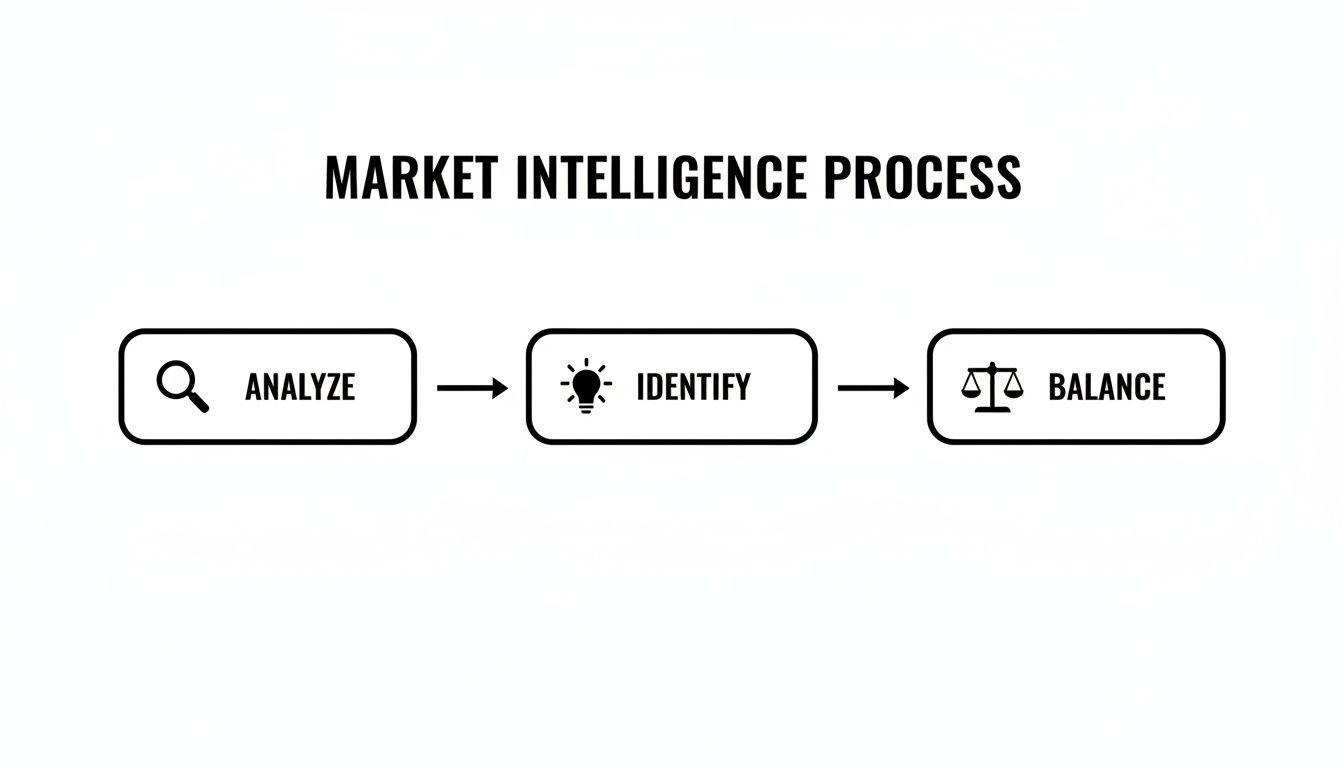
This workflow shows how you move from analyzing a market to identifying the key drivers for each student segment. That insight allows you to strike a balance, keeping your message globally consistent while making it locally relevant.
Let’s put this into practice. Imagine your university is known for its incredible hands-on research opportunities.
- For a German Engineering Applicant: You'd want to highlight the structured lab work, your connections to industry giants like Siemens or Bosch, and the technical precision of the curriculum. The message here is all about technical excellence and career preparation.
- For a Brazilian Environmental Science Applicant: You would showcase research projects tied to the Amazon, faculty with experience in sustainable development, and opportunities for immersive fieldwork. The message shifts to impact and passion.
The core strength—research—remains the same. But the story you tell is tailored to resonate with completely different cultural and career aspirations.
Addressing Sensitive Topics with Honesty
Some of the biggest worries for international students are the very topics institutions are often hesitant to discuss: visa rules, financial aid, and safety. Ignoring these issues doesn't make them vanish; it just breeds uncertainty and erodes trust. A proactive, honest communication strategy is always more effective.
Take visa anxiety, for example. It's a huge hurdle for many applicants. Instead of just dropping a generic link to a government website, address it head-on:
- Host a webinar with an immigration advisor who can answer live questions.
- Create a simple, step-by-step visa application checklist.
- Share video testimonials from current students who successfully navigated the process.
This direct approach shows you understand their stress and that you're a reliable partner who will help them through it.
Don't shy away from the tough questions about cost, visas, or safety. Addressing these topics with transparency and providing clear, helpful resources is one of the most powerful ways to build trust with prospective students and their families.
The global market is also constantly shifting. Right now, the UK's international student market is at a fascinating inflection point. While undergraduate demand holds strong, postgraduate programs are seeing a slowdown. Applicants are weighing safety and value more heavily, exploring alternatives in continental Europe or even Asian hubs like South Korea and Japan, which offer lower costs and better local job prospects.
Knowing these macro trends is essential for crafting timely messages. You can read more about the evolving state of the international student market on The PIE News. By acknowledging these shifts in your communications, you show that your institution is tuned in to the real-world pressures students are facing today.
Optimizing Your Recruitment Channel Mix
Having a powerful message is one thing, but getting it in front of the right students at the right time is where the real work begins. A scattergun approach—a little digital here, a few agent contracts there—just doesn’t deliver. The goal is to build a smart, integrated international student recruitment strategy where every channel works in concert to meet students exactly where they are.
This means moving past a heavy reliance on a single source, like recruitment agents. While agents have incredible in-market expertise, a healthy strategy also uses a strong digital engine to bring in direct leads. This doesn't just spread your risk; it builds a more sustainable model by lowering your cost per acquisition over time.
Building Your Digital Foundation
Think of your digital presence as your 24/7 recruitment office. For most prospective students, it's their first, and most important, interaction with your institution. You simply can't compete for modern applicants without a solid digital footprint.
Your digital efforts need to be a coordinated system, not just a bunch of disconnected tactics. The idea is to create a seamless journey that gently guides a student from that first moment of awareness all the way to a submitted application.
- Localized SEO and Content: Don't just translate your website—truly localize it. Get into the weeds and find out what students in Vietnam are searching for versus students in Nigeria. Then, create content that directly answers their most pressing questions about program outcomes, what student life is really like, and how to navigate the visa process. Use their language and culturally relevant examples.
- Targeted Social Media Advertising: You have to go where your audience lives online. A campaign for postgraduate programs in India will likely hit its stride on LinkedIn and Facebook. Meanwhile, you might find that undergraduate recruitment in South Korea gets far more traction on Instagram. Get specific with your targeting to reach students interested in certain fields or even those looking at your direct competitors.
- Programmatic Advertising: This is your secret weapon for hyper-targeted ads. It lets you serve display and video ads to very specific student segments across thousands of websites. Imagine targeting users who just visited a university search portal or browsed articles about studying abroad—that’s how you make sure your budget is only spent on people who are already in the market.
The Strategic Role of Agents and Partners
Even as you build up your direct channels, recruitment agents remain a cornerstone of a diversified strategy. The trick is to treat them like genuine partners, not just lead funnels. A well-managed agent network provides the kind of on-the-ground intelligence and local trust that's incredibly difficult to build from thousands of miles away.
The most effective recruitment strategies create a symbiotic relationship between digital and agent channels. Digital campaigns build brand awareness and generate initial interest, making the agent's job of converting qualified students easier and more efficient.
To make this partnership succeed, you need a clear framework. Set expectations from the start, provide regular training on what makes your institution special, and be transparent about commissions. Your best agent partners should feel like an extension of your own team—they get your brand and can communicate it authentically.
Knowing When to Go In-Country
Digital channels and agent networks are powerful, but let’s be honest: sometimes, nothing beats a face-to-face conversation. An in-country event, when timed and targeted just right, can be the final nudge that convinces a promising student to enroll. The catch? The cost of travel and logistics means you have to be incredibly strategic.
Only invest in on-the-ground events when you have a crystal-clear objective:
- Entering a New Market: Attending a major education fair can be a fantastic way to introduce your brand to a new audience and gauge interest.
- Converting High-Value Leads: Host small, exclusive "meet and greet" events for applicants who have already received an offer. That personal touch can do wonders for your yield rate.
- Strengthening Agent Relationships: Visiting your partners in their home offices shows you’re committed. It’s also the perfect opportunity for in-person training and brainstorming new strategies together.
Ultimately, getting your channel mix right is all about balance and measurement. You have to constantly track the ROI from every channel—from the click-through rate on your digital ads to the final enrollment numbers from each agent. This data-first approach shows you what’s working, lets you cut what isn’t, and ensures your budget is making the biggest possible impact.
Using AI to Scale Your Recruitment Efforts
Let’s be honest: most recruitment teams are swimming in data but struggling to use it. This is where Artificial Intelligence stops being a buzzword and becomes a practical, powerful part of your international student recruitment strategy. It's not about replacing your team; it's about giving them the power to build thousands of genuine connections at a scale that was once unthinkable.

The right AI tools can handle the repetitive, time-sucking tasks that drain your admissions staff. This frees them up for what people do best—building rapport, answering nuanced questions, and personally guiding qualified applicants through their final decisions.
Automating Personalized Outreach at Scale
We all know personalization is essential, but manually writing unique emails for thousands of inquiries is an operational nightmare. This is exactly the problem AI-powered platforms were built to solve by automating hyper-personalized messages based on a student’s profile and actions.
Imagine a prospective student from Brazil downloads a brochure for your engineering program. An AI system can instantly kick off a tailored email sequence:
- Email 1 (Immediately): Delivers the brochure, but also includes a link to a video testimonial from a current Brazilian engineering student.
- Email 2 (2 Days Later): Follows up by highlighting your university's internship connections with tech companies relevant to their field.
- Email 3 (1 Week Later): Invites them to a webinar specifically for Latin American applicants to discuss the visa process and student life.
This isn’t just an email blast. It’s a thoughtful, automated conversation that makes each student feel seen and understood, nurturing their interest far more effectively.
Deploying AI for 24/7 Multilingual Support
One of the easiest wins with AI is an intelligent chatbot on your international admissions pages. Prospective students are researching from every time zone, often well outside your team's 9-to-5 schedule. A good chatbot offers instant, 24/7 support.
And these aren't the clunky, frustrating bots from a few years ago. Modern AI chatbots can:
- Answer common questions in multiple languages about deadlines, tuition, and program requirements.
- Pre-qualify leads by asking smart questions about their academic background and goals.
- Schedule meetings directly on a recruiter's calendar when they identify a high-intent inquiry.
This immediate help dramatically improves the applicant experience and ensures you never lose a great lead simply because your office was closed.
The real power of AI in recruitment lies in its ability to handle the high-volume, low-complexity tasks. This gives your human team the bandwidth to focus on the high-touch, high-impact interactions that actually drive enrollment.
Using Predictive Analytics to Focus Your Efforts
Not every inquiry has the same potential. Predictive analytics is a game-changer here, using AI to sift through thousands of data points from past applicants to pinpoint which new inquiries are most likely to enroll. The system assigns a lead score based on factors like country of origin, program of interest, and how they engage with your website and emails.
This data-driven insight allows your team to prioritize their follow-up with surgical precision. Instead of a first-come, first-served approach, they can dedicate their valuable time to the students showing the strongest signals of intent.
This simply leads to a more efficient team and, ultimately, a better yield rate. Your best people are spending their energy where it matters most.
Here’s a look at how different AI tools map to the recruitment funnel.
AI-Powered Recruitment Toolset
|
AI Application |
Recruitment Stage |
Example Tool/Platform |
Key Benefit |
|---|---|---|---|
|
Intelligent Chatbots |
Awareness & Inquiry |
Provides 24/7 support and pre-qualifies leads. |
|
|
Personalized Email Automation |
Nurturing |
Delivers tailored content at scale to move leads down the funnel. |
|
|
Predictive Lead Scoring |
Qualification |
Prioritizes high-potential applicants for recruiters. |
|
|
Market Trend Analysis |
Strategy & Planning |
Identifies emerging markets and program demand. |
By thoughtfully integrating these tools, you’re not just automating tasks—you’re building a smarter, more responsive recruitment engine. This tech-enabled approach helps you analyze new market trends, spot opportunities you might have missed, and ensure your team is always focused on the most promising leads.
Measuring What Matters for Future Growth
Let's be honest: an international student recruitment strategy is only as good as the results it produces. To get the resources you need and prove your team's value, you have to look past the easy numbers like total applications. The real story—the one your leadership actually cares about—is in the data that ties your work directly to the institution's bottom line.
This means we need to stop asking "how many applied?" and start asking "what did it cost to enroll one student?" Your senior leadership is thinking about return on investment, and so should you. As markets get tougher and more crowded, acquisition costs can spiral. Keeping a close eye on these expenses isn't just a good habit; it's a survival tactic.
Defining Your Core Recruitment KPIs
First things first, you need to identify a small handful of Key Performance Indicators (KPIs) that genuinely define success. These are your North Star metrics. They should guide every single decision you make about your time, effort, and budget. It's time to ditch the vanity metrics and focus on what actually moves the needle.
Your must-have KPI dashboard should track:
- Cost Per Enrollment (CPE): This is your ultimate efficiency metric. To find it, divide the total cost of a specific recruitment channel or campaign by the number of students who actually showed up on campus from that effort. It’s that simple.
- Yield Rate by Market: Of all the students you admitted from a particular country, what percentage actually enrolled? If your yield rate is fantastic in Vietnam but lagging in India, that’s a huge clue about where your message is hitting home and where it needs work.
- Channel-Specific ROI: You have to track the performance of each channel separately. Are your digital ads bringing in students? What about your agent partners or the fairs you attend? Knowing your programmatic ads have a $5,000 CPE while a particular agent network is costing you $12,000 per student gives you a crystal-clear roadmap for where to put your money.
An effective strategy is built on a simple premise: if you can't measure it, you can't manage it. Focusing on financial metrics like CPE and ROI transforms the recruitment office from a cost center into a clear driver of institutional revenue.
From Measurement to Strategic Budgeting
Once this data starts rolling in, you can build a budget that’s agile and, most importantly, defensible. Gone are the days of asking for a flat number and hoping for the best. Now, you can walk into a meeting with a plan backed by hard numbers.
Imagine being able to show your leadership team that a $50,000 investment in localized SEO for South American markets brought in 10 students at a $5,000 CPE. You're no longer just spending money; you're directly generating revenue.
This data-first approach also lets you make smarter bets. Maybe you'll decide to allocate 70% of your budget to the channels and markets you know work well. But you can then dedicate the other 30% to carefully planned experiments—testing a new region, trying out an emerging social media platform, or piloting a new partnership. This gives you a balanced portfolio that manages risk while actively hunting for the next big opportunity.
The final piece of the puzzle is reporting your findings clearly. Don't just present a spreadsheet. Frame your reports around the institution's financial health. When you can demonstrate how your diversified market strategy and optimized channel mix are lowering acquisition costs and boosting net tuition revenue, your international recruitment efforts become an undeniable asset to the entire institution.
Got Questions? We’ve Got Answers
Putting a modern international recruitment strategy into practice always brings up some tricky questions. Here are some straightforward answers to the challenges we see university leaders and admissions teams grapple with most often.
We’re Over-Reliant on a Couple of Big Markets. How Do We Branch Out?
Relying too heavily on one or two countries is a risky game. A sudden policy change or economic downturn can put a huge dent in your pipeline. The smartest move is to start diversifying.
First, dig into the market intelligence. Pinpoint three to five up-and-coming countries where there's a clear demand for what you offer—think of places like Indonesia or certain nations in Latin America that are showing real growth potential.
You don't need a massive budget to get started. Carve out a small, experimental fund to test some digital campaigns in these new regions. The goal is to build your brand directly with students through localized content and social media. This gives you a foothold that isn't totally dependent on agent networks and creates a much more balanced, resilient recruitment portfolio.
We Want to Use AI in Recruitment, But Where Do We Even Begin?
The best place to start is also the easiest: get an AI-powered chatbot running on your international admissions pages. It's a quick win with a big impact.
A good chatbot can handle common questions 24/7 in multiple languages, grab lead information when your office is closed, and even help pre-qualify prospects.
This single move immediately makes your team more efficient and vastly improves the applicant experience. It takes all those repetitive, low-level questions off your team’s plate, freeing them up to have meaningful, high-value conversations with candidates who are genuinely ready to talk.
How Can We Actually Prove the ROI of Our Digital Channels?
You can't manage what you don't measure. To get a real handle on ROI, you need to track a student's entire journey, from their very first click right through to their enrollment deposit.
This means using a CRM that can properly track attribution. Set up your campaigns with UTM parameters so you can see exactly where every single application came from—whether it was a Google Ad, an organic search, or a specific social media post.
From there, the math is simple. Calculate the cost per enrollment for each channel by dividing what you spent by the number of students who actually enrolled. This data is gold. It shows you, in black and white, which strategies are paying off and where you should be investing more of your budget.
At AIxGrowth, we build AI-powered marketing operations that help universities and colleges scale their recruitment and hit their growth targets. See how we can help you build a smarter strategy at https://aixgrowth.ai.