

Every team producing content with AI ends up in the same loop – AI produces a content draft, it reads almost right, then someone fixes it by hand. The next draft has the same problems in different places. So the prompt gets updated with another paragraph of instructions.
The prompt keeps growing. The drafts still don't get better.
I ran this loop for months before the obvious thing hit me – everything I needed to teach the system was already sitting in my edits. I was producing perfect training data every day and throwing it away.
What an edit knows that a prompt doesn't
A prompt is what you think you want, written before the work exists. An edit is what you actually did to real output before you were willing to put your name on it.
Those are two different grades of information. When I write a prompt, I'm guessing which instructions will matter. When I cut a sentence, rewrite an opening or delete a whole section, there's no guessing involved. That's the standard itself, demonstrated on a real case.
Most teams treat those edits as cleanup. Fix, publish, forget. That's the most precise feedback their system can ever get but it's being discarded daily.
The loop I run instead
I write articles through a system I built for exactly this problem. Here's how it works.
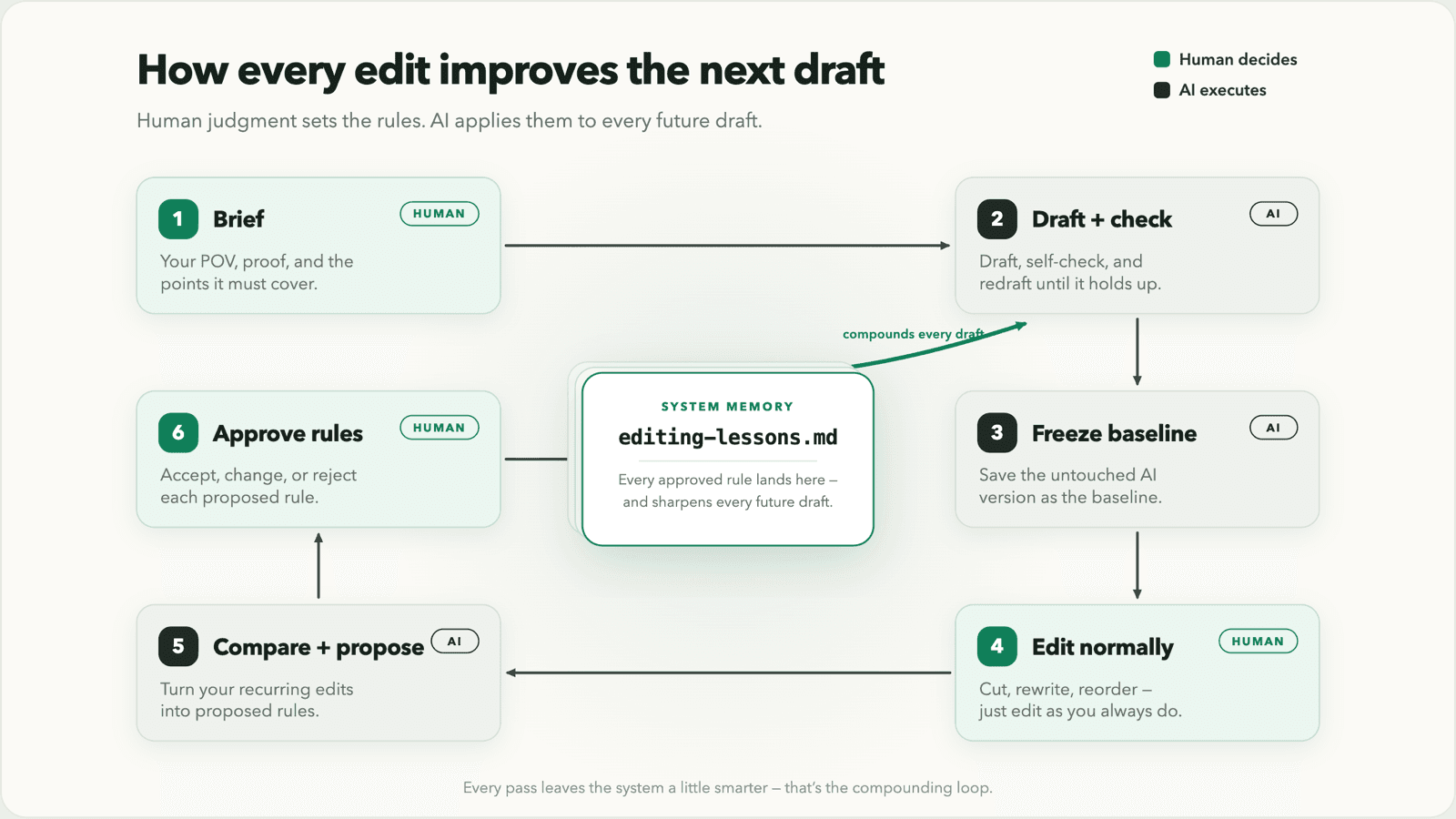
Every article starts from a topic brief that carries my take – the one idea, my proof, and things that need to be covered. The AI drafts against a written quality gate – voice rules, a banned-words list, structure checks, a requirement that every claim carries real proof. If a draft fails a check, it redrafts before delivery. I only see final drafts that pass.
Then before I touch a draft, the system freezes a copy of it. I edit the live version the way I'd edit anything – cut, rewrite, move, delete. When I'm done, the system compares my version against the frozen one and proposes what it learned as short rules, each with a before-and-after example pulled from the actual diff.
I approve or reject each rule. Approved ones land in a file called editing-lessons.md. Every future draft reads that file before a word gets written.
And a rule I've had to apply twice gets promoted into the quality gate itself – a hard check every draft must pass before it reaches me. I correct a pattern once, maybe twice. I don't correct it a third time.
An actual example
My drafts used to arrive with comparison clauses bolted onto finished sentences. Like this...
"A hands-on working session, not another webinar of generic slides."
I'd then ask it to edit every time the same way – cut out everything after the comma. The sentence was done before the comparison.
I did that numerous times before i turned it into a rule with a before/after example in the lessons file. It takes one editing session to teach AI and future drafts never repeat it.
One rule sounds small. Thirty rules, extracted from real edits and checked on every draft, is the difference between AI slop and AI output you publish.
Two rules that make the system better over time
Nothing saves without my explicit approval. The system proposes lessons, I confirm each one before it's stored. A wrongly inferred rule would repeat across every future article, so this step is absolutely critical.
And the lessons file gets consolidated every ten articles. Duplicates merge, one-off preferences retire, proven patterns graduate into the permanent voice rules.
Build this yourself
You can create this in your AI tool that supports custom commands (Claude Code, Codex, Cursor etc), just by pasting this prompt:
Create a slash command called /extract-editing-lessons.

When I run it after an editing session, it should:

1. Ask me for the AI's original draft and my final edited version
   (file paths or pasted text).
2. Compare the two and list every meaningful change I made – cuts,
   rewrites, reordering, tone shifts. Ignore typo fixes.
3. Turn the recurring changes into short rules written as
   instructions for future drafts, each with one before/after
   example taken from the actual diff.
4. Show me the proposed rules one by one. I approve, edit or reject
   each. Nothing is saved without my approval.
5. Append approved rules to a file called editing-lessons.md,
   grouped under: voice, openings, structure, evidence, cuts,
   never do.
6. End by reminding me to include editing-lessons.md in the context
   of every future draft.
Run it after every heavy editing session. Ten sessions in, you'll have a page of rules no prompt library could have given you, because they came from your hands.
If you're looking to make your business workflows AI-native – systems that learn how you work instead of waiting to be re-instructed – contact us at AIxGrowth.